Which Train-the-Trainer Certification Is Right for Me?
Confused by the different trainer certifications available in Malaysia?
Before choosing a certification, it’s important to understand that not every trainer qualification serves the same purpose.
Malaysia has different pathways for trainers depending on what you intend to teach, who you want to train for, and which training or TVET ecosystem you want to work in.
This guide focuses specifically on Train-the-Trainer (TTT) certifications and helps you understand which TTT pathway may be relevant to your goals.
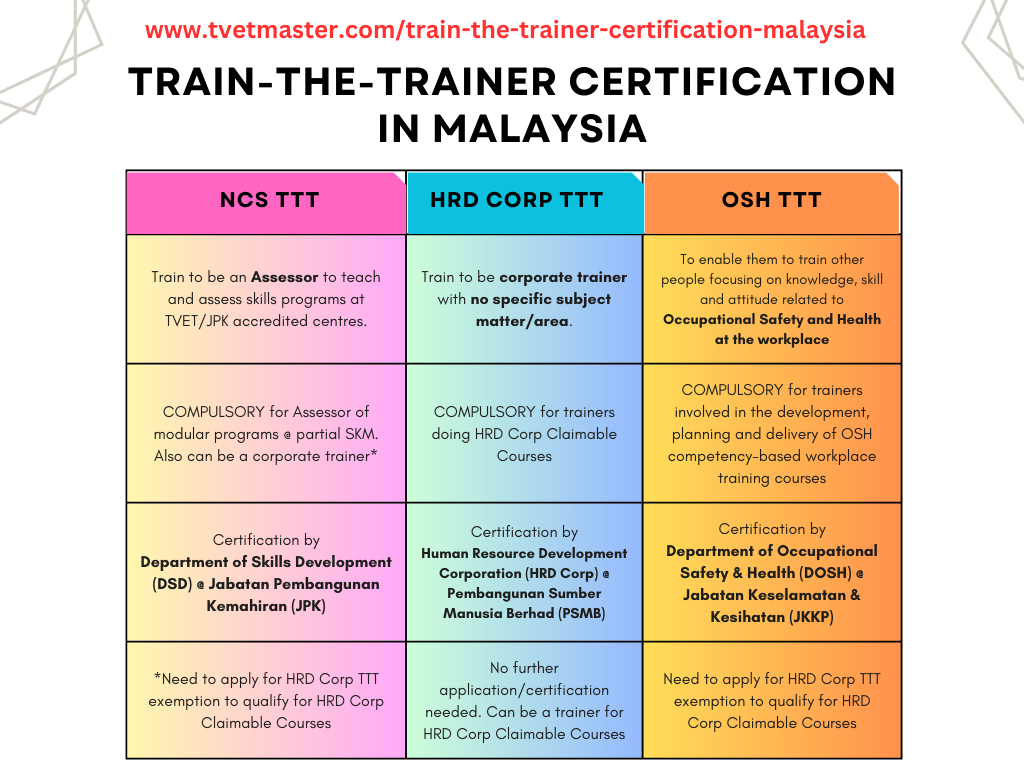
Table of Contents:
I. Importance of Train the Trainer Certification in Malaysia
II. Benefits of Train the Trainer Certification
III. How to choose the right Train the Trainer Certification Course
IV. Conclusion
I. Importance of Train the Trainer Certification in Malaysia
Train the Trainer Certification in Malaysia is essential for anyone who wants to become a successful trainer. The certification program provides trainers with the necessary knowledge and skills to design, develop, and deliver effective training programs. Train the Trainer Certification is also important for those who are looking to enhance their career prospects in the field of training and development.
II. Benefits of Train the Trainer Certification:
- Enhance Training Skills: Train the Trainer Certification program provides trainers with the necessary skills to design and deliver effective training programs.
- Increase Potential Income: Additional opportunity to conduct HRDC Claimable Courses (with HRDC-TTT cert or exempted cert) where contributing employers need not to pay training fees using their fresh fund but just utilise whatever levy balance that they have with HRDCorp.
- Employability: With Train the Trainer Certification, trainers can improve their chances of getting hired by reputable organizations or opportunity to be Assessor (modular programs) at TVET accredited centres (especially with NCS-TTT)
- Stay Up-to-Date: The certification program ensures that trainers are up-to-date with the latest training techniques and best practices.
- Improve Training Outcomes: Trainers who have undergone Train the Trainer Certification can deliver high-quality training programs that improve the learning outcomes of participants.
III. How to choose the right Train the Trainer Certification Course:
- Accreditation: Choose a certification course that is accredited by a reputable organization. In Malaysia, the three main governmental bodies is Human Resource Development Corporation, Department of Skills Development & Department of Occupational Safety & Health.
Tips: By taking NCS-TTT or OSH-TTT, you have the advantage of gaining another HRDC-TTT exemption certificate - Course Content: Look for a certification course that covers the latest training techniques and best practices.
Tips: Look for those that provide value added topics/tools like Gen AI Tools, gamification techniques etc - Trainer Experience: Choose a certification course that is delivered by experienced trainers.
Tips: Check how long has the trainer been conducting train the trainer course (including training skills trainer) - Mode of Delivery: Choose a certification course that is delivered in a mode that suits your schedule and learning preferences.
- Post training support: What kind of support is provided post training?
Tips: Any guidance for exemption (for NCS-TTT & other qualified certifications) & accreditation (to be accredited trainer)? Beware though, some only promise upfront but never provide or charge sky-high fee to guide.
Wait — What About TVET Trainer Certification?
If your goal is to become a TVET trainer, don’t assume that the above Train-the-Trainer certificate is automatically the right qualification.
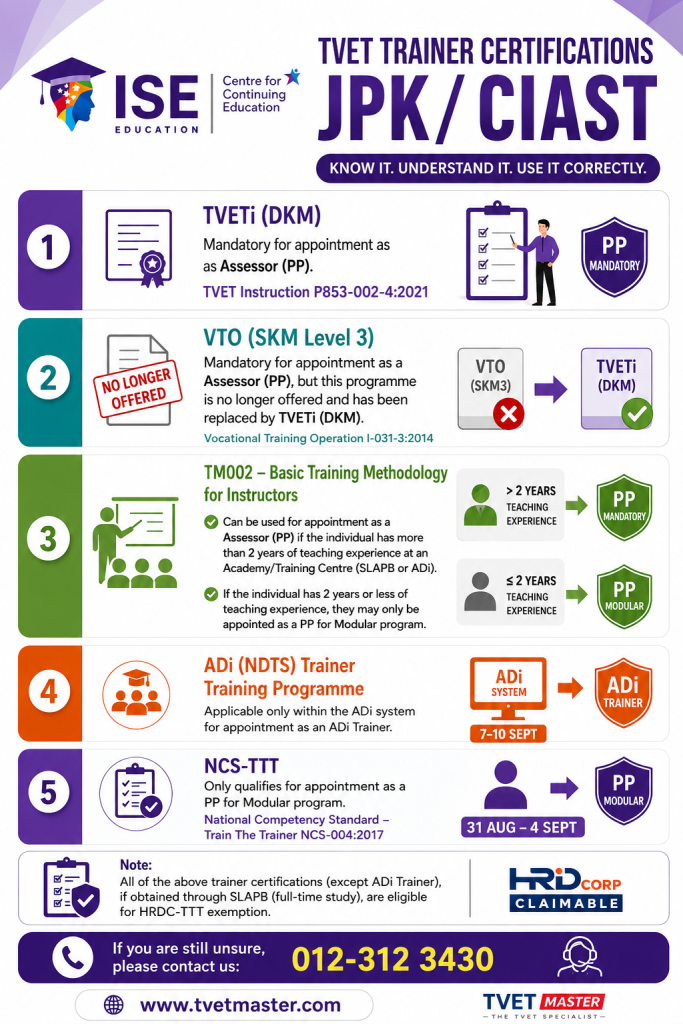
So, Which Pathway Is Right for You?
I want to conduct HRD Corp claimable training only
→ Look at HRD Corp-TTT
I want to work within the JPK training ecosystem AND/OR conduct HRD Corp claimable training
→ Look at the NCS-TTT
I want to become a TVET Trainer
→ Investigate the appropriate TVET trainer certifications, rather than assuming HRD Corp-TTT is sufficient.
I want to train in an ADI(NDTS) environment
→ Look specifically at the ADI(NDTS) trainer requirements.
Conclusion:
Train the Trainer Certification is a vital program for anyone who wants to become a successful trainer in Malaysia. The certification program provides you with the necessary skills to design, develop, and deliver effective training programs. To choose the right certification course & training provider, consider your target markt, the accreditation, course content, trainer experience, mode of delivery, and cost. With the right certification, trainers can enhance their skills, increase their employability, stay up-to-date, and improve training outcomes.
FAQ's
1. What is Train the Trainer Certification?
Train the Trainer Certification in Malaysia is a program designed for trainers who want to enhance their skills in designing, developing, and delivering effective training programs.
2. Why is Train the Trainer Certification important?
Train the Trainer Certification is important for anyone who wants to become a successful trainer. The certification program provides trainers with the necessary knowledge and skills to design, develop, and deliver effective training programs.
3. Which Train The Trainer Certification should I choose?
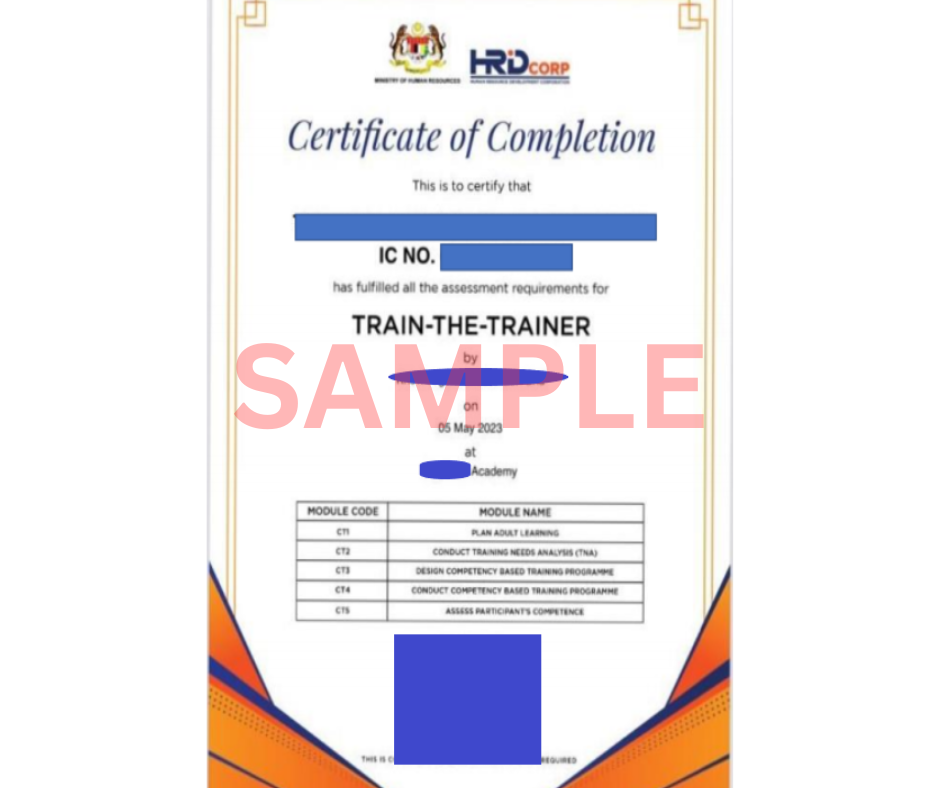
i) HRD Corp-TTT certification
Required to be a HRD Corp Accredited Trainer that will allow your training programs to be claimable by HRD Corp registered employers.
ii) NCS-TTT certification
Required to be an Assessor for Modular/Micro Credential Programs@ in JPK Accredited centre.
Can also apply for HRD Corp – TTT cert exemption* but not vice versa.
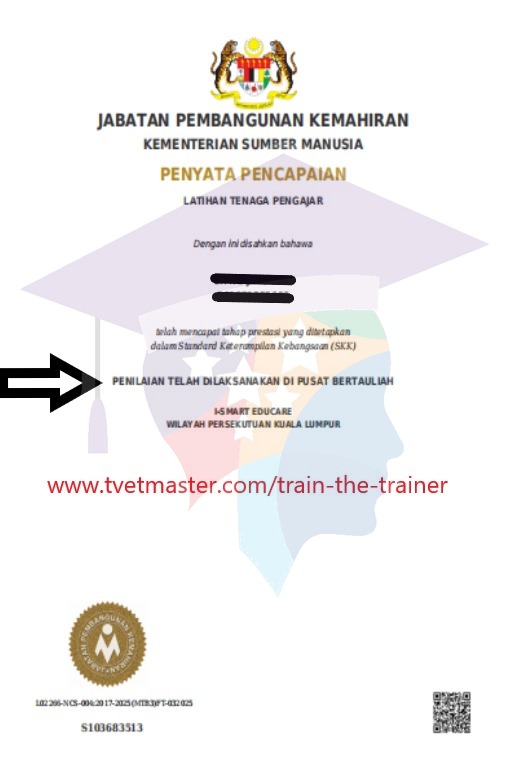
* Exemption is only allowed for those who obtained their NCS-TTT through a Pusat Bertauliah (pls refer to the sample below – Penilaian Telah Dilaksanakan di Pusat Bertauliah I-Smart Educare)
iii) OSH TTT certification
Required by all trainers responsible for OSH
Can also apply for HRD Corp – TTT cert exemption but not vice versa.
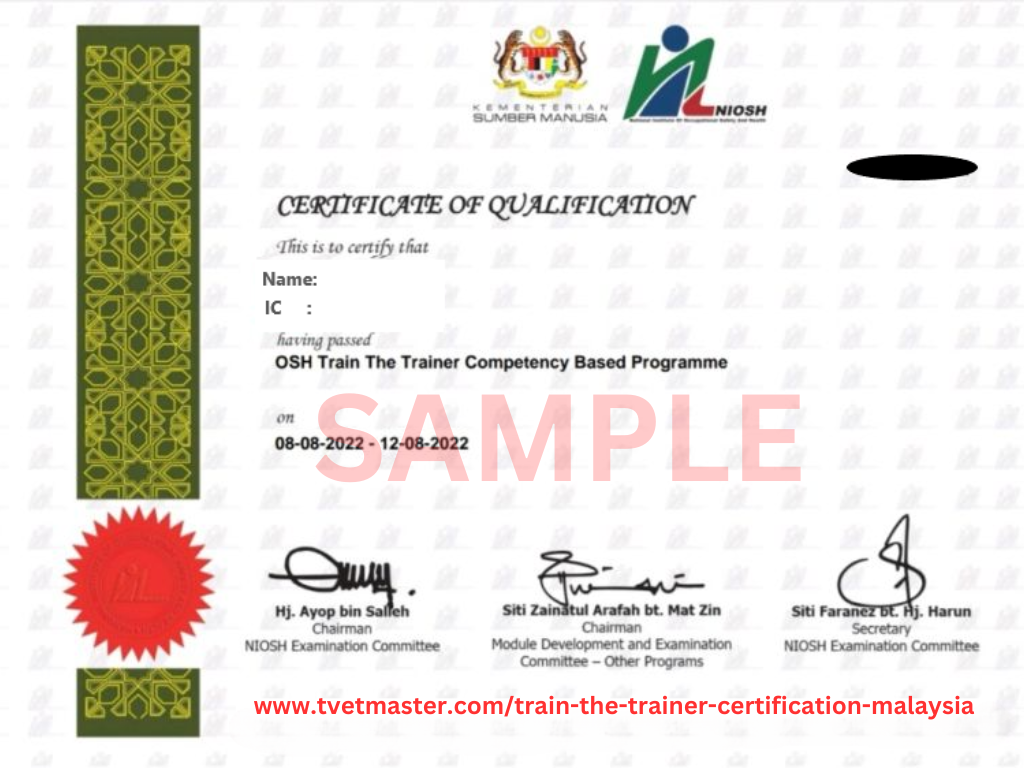
Application for HRD Corp-TTT exemption: NCS-TTT & OSH-TTT
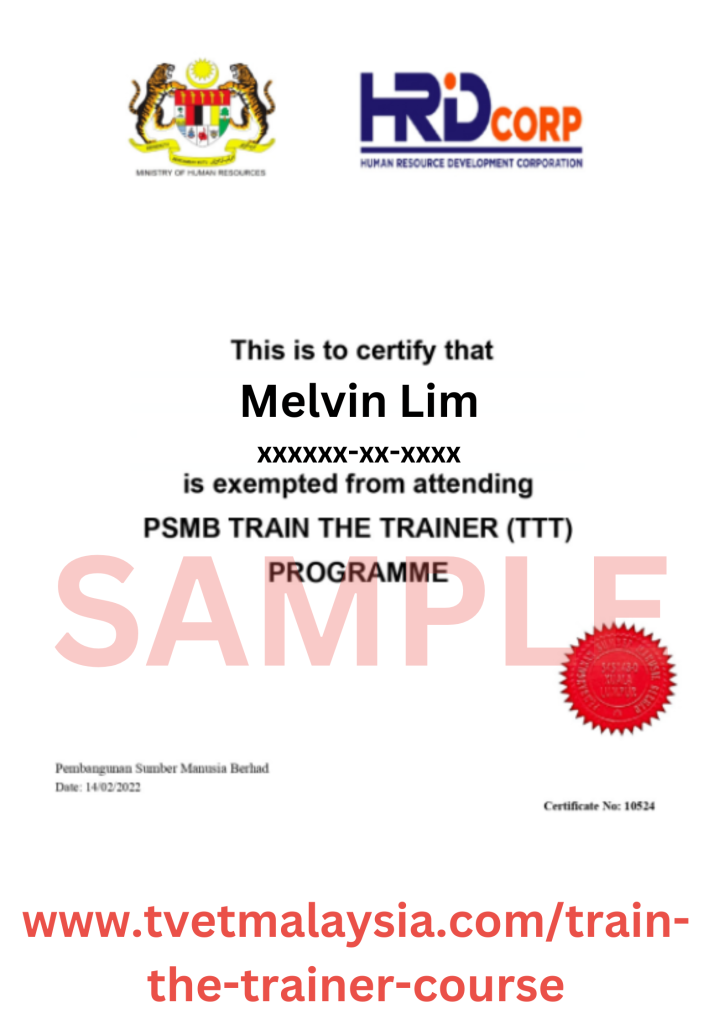
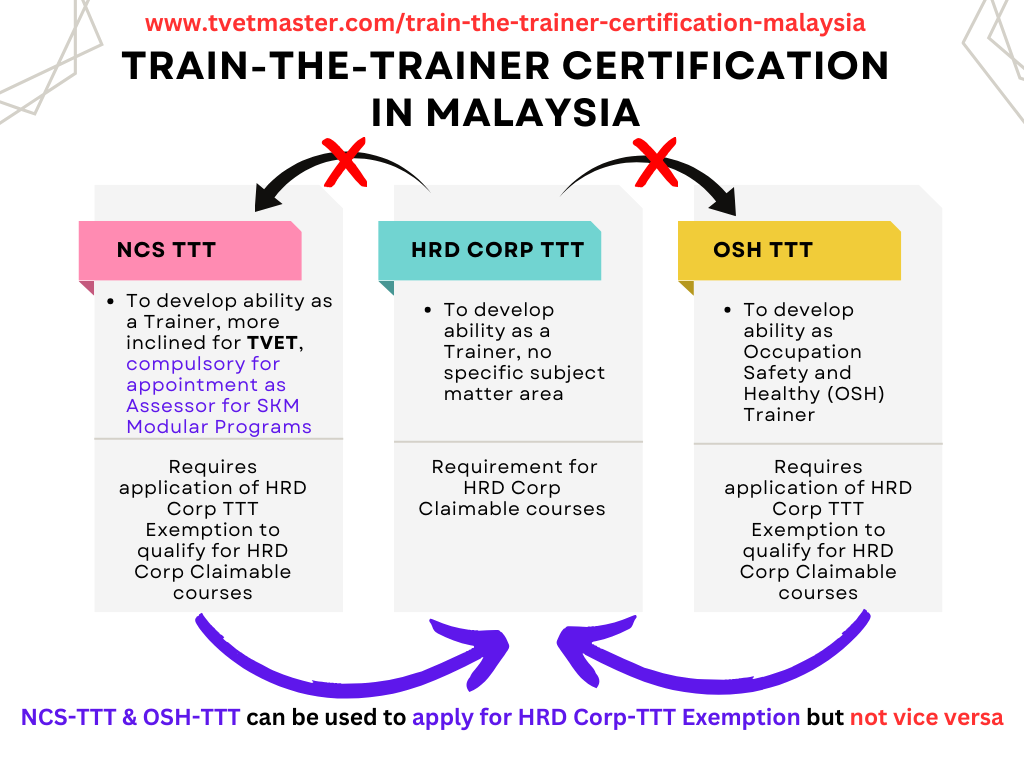
From this table, you can see that it is more value for money to obtain either NCS-TTT or OSH-TTT instead of HRD Corp-TTT due to the opportunity to obtain dual certification.
If you’re not strictly in Occupational Safe & Health industry, the better choice is NCS-TTT as it has a broader base of usage as it’s relevant to over thousands of National Occupational Skills Standard (NOSS) – for the appointment as Pegawai Penilai Modular
4. Who should undergo Train the Trainer Certification?
Managers, executives, trainers, instructors, educators and basically anyone who wants to:
i) Enhance their career prospects in the field of training and development
ii) Enhance their competencies in Curriculum Development, Training Delivery, Assessment and Evaluation
iii) Become a successful trainer in Malaysia
i) HRD Corp-TTT – All trainers planning to conduct HRD Claimable courses
ii) NCS-TTT – All Assessors (PP-M) for TVET Modular programmes (and also who wants to conduct HRD Claimable courses)
iii) OSH-TTT – All trainers responsible for Occupational Safety & Healthy (OSH) (and also who wants to conduct HRD Claimable courses)
5. What are the benefits of Train the Trainer Certification?
The benefits of Train the Trainer Certification include enhancing training skills, increasing employability, staying up-to-date with the latest training techniques and best practices, and improving training outcomes.
6. How long does it take to complete Train the Trainer Certification?
The duration of Train the Trainer course is 5 days
7. What is the cost of Train the Trainer Certification in Malaysia?
The cost of Train the Trainer Certification in Malaysia varies depending on the type of TTT and also the institution offering the program.
8. What is the mode of delivery for Train the Trainer Certification? Train the Trainer
Courses can be delivered in either classroom-based or remote learning@online (NCS-TTT is not allowed to be conducted via online, beginning from 28th Jan 2026).
9. What is covered in Train the Trainer Certification courses?
1. HRD Corp-TTT
Module 1: Plan Adult Learning
- Fundamentals of adult learning and training
- Principles of adult learning
- Competent trainers characteristics
- Ethics guide for trainers
Module 2: Conduct Training Needs Analysis (TNA)
- Overview of Training Needs Analysis (TNA)
- TNA Methods
- Competency Gap Analysis
- Outcomes of TNA
Module 3: Design Competency Based Training Program
- Program requirements
- Training resources development
- Training design development
Module 4: Conduct Competency Based Training Program
- Methods of training delivery
- Presentation and facilitation skills
- Learning supports
- Session plan
Module 5: Assess Participant’s Competence
- Introduction to Competency Based Assessment
- Introduction to assessment
- Types of assessment
- Assessment administration
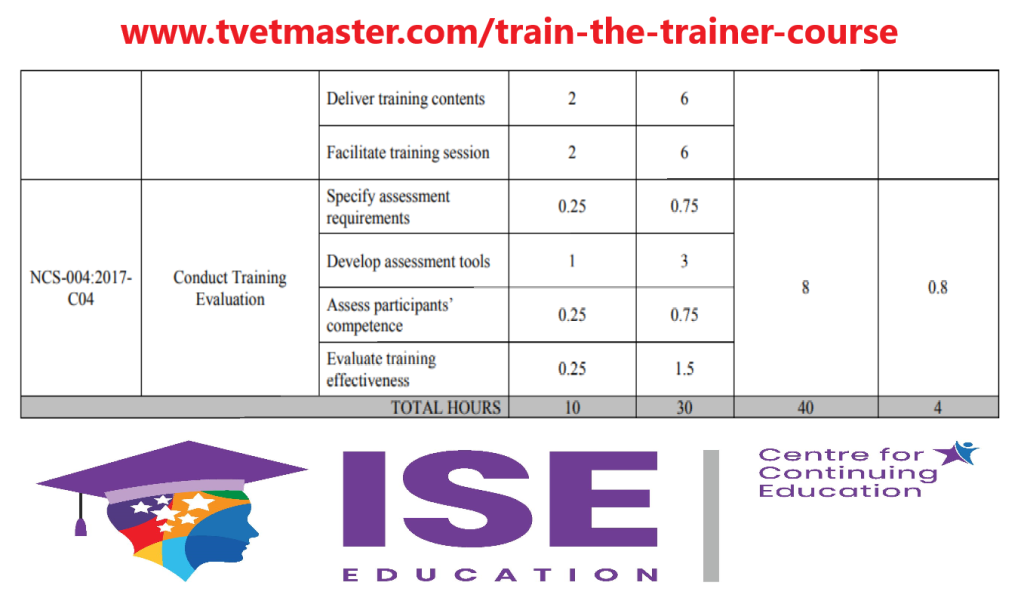
2. NCS-TTT
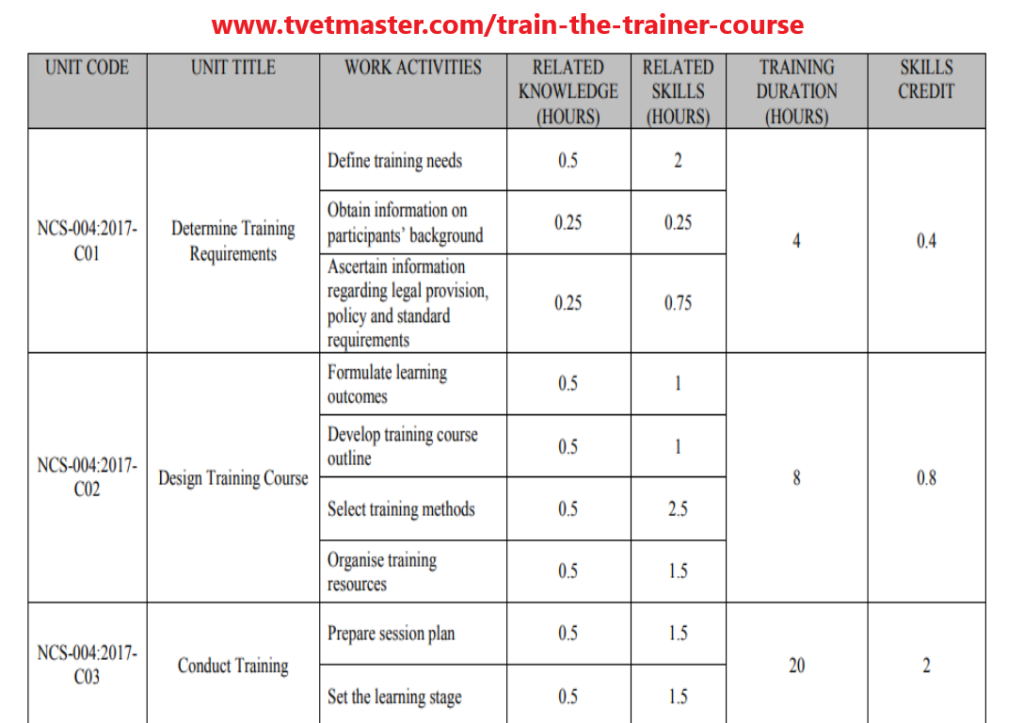
3. OSH-TTT Competency Based Training Programme
Module 1: Training Environment
i. Introduction to OSH Train the Trainer Competency Based Programme.
ii. Work Effectively in Education and Training.
iii. Foster and Promote an Inclusive Learning Culture.
iv. Ensure a Healthy and Safe Learning Environment
Module 2: Training Needs Analysis (TNA)
i. TNA Terminology.
ii. Levels of TNA.
iii. TNA Requirement.
iv. Personal TNA Development.
Module 3: Designing and Delivering Training
i. Provide Training Through Instruction and Demonstration of Work Skills.
Module 4: Basic Assessment
i. Plan and Organise Assessment and Assess Competence.
ii. Preparation of Presentation Document.
How to choose the right Train the Trainer course provider?
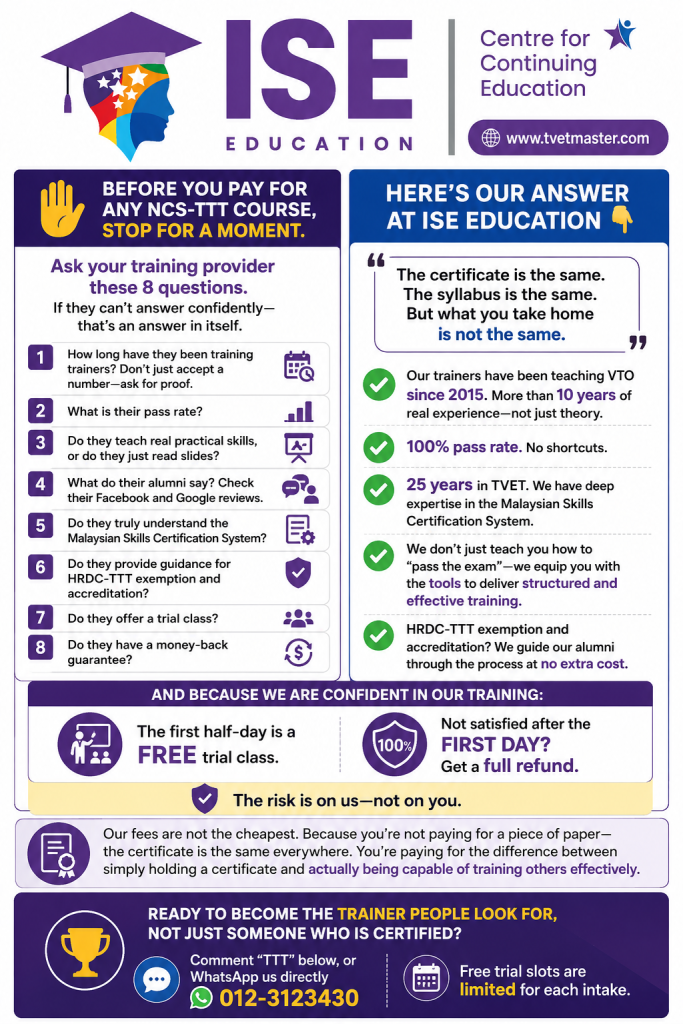
To choose the right Train the Trainer Certification course provider, consider the trainer experience, track record, reviews by past graduates, accreditation, course content & equally important, after sales service (like guiding on exemption, accreditation).
Are You Ready to be A Nationally Recognised & Certified Trainer?