Program latihan untuk menghasilkan pengajar yang berketerampilan sebagaimana keperluan Akta 652 (NASDA) Standard 6 dan kriteria menjadi PP iaitu : “Memiliki sekurang-kurangnya SKM bidang pengajar vokasional atau sijil perguruan vokasional atau sijil latihan mengajar vokasional yang diiktiraf oleh JPK/MLVK”
Ramai yang selalu tanya apakah syarat ambil VTO sebab nak jadi pengajar. Tapi rasanya ramai juga yang tidak tahu bahawa selain kelayakan sijil VTO, dua lagi sijil yang diperlukan untuk dilantik sebagai pengajar vokasional (biasanya Pegawai Penilai juga):
1) Sijil induksi PP-PPD-PPB (memahami Sistem Persijilan Kemahiran Malaysia) – kursus 2 hari 2) Sijil Kemahiran Malaysia (SKM) bidang kemahiran anda (cth elektrikal, automotif, kulinari, pendidikan awal kanak-kanak dsbgnya)
Tempoh sijil induksi anda dah tamat?
Bagi yang dah ada sijil induksi PP-PPD-PPB pula, tahukah anda ia ada tempoh tamat jika tak dilantik? (tak dilantik dlm tempoh 3 tahun sejak lulus induksi)
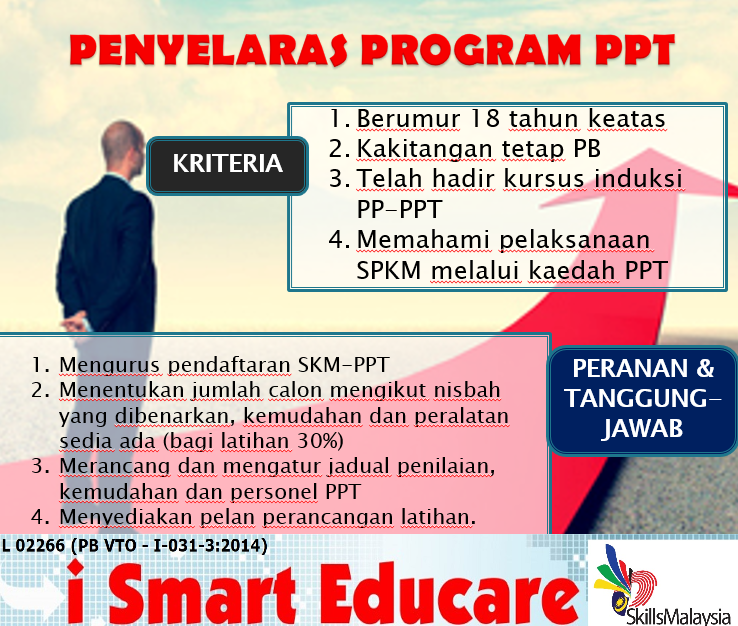
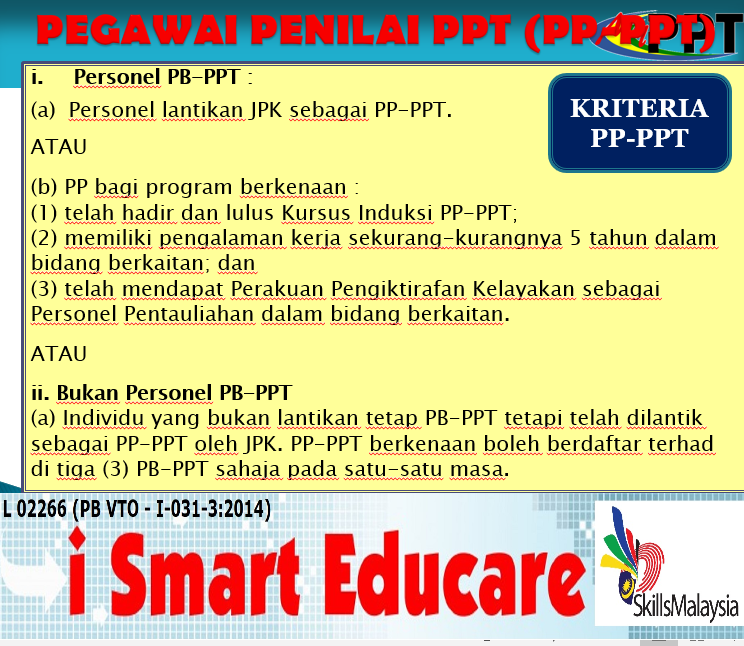
PP-PPT 1. Kiranya nak jadi PB-PPT, kena ada penyelaras PPT yg telah ikuti kursus induksi PP-PPT
2. Kiranya nak dilantik jadi PP-PPT bidang kemahiran anda (dah ada SKM & >10 thn pengalaman kerja) 3. Kiranya dah baca Panduan Permohonan SKM melalui PPT tapi masih tak tahu lagi macam mana nak mula.
Masa: 8.30-5pm Yuran: RM350 termasuk nota, minum pagi, makan tengah hari & sijil dari JPK Bayaran atas nama: ISE Education Sdn Bhd, Maybank 514589385943
Tunggu apa lagi jika takda sijil diatas tapi minat untuk jadi pengajar vokasional atau PP-PPT?
Muat turun borang disini Lepas isi & buat bayaran, sila emel slip bayaran serta borang permohonan anda ke ismarteducare@gmail.com
Nurul Izzah will head a new committee on the government’s Technical and Vocational Education and Training (TVET) programme. — Picture by Yusof Mat Isa
PUTRAJAYA, June 21 ― Permatang Pauh MP Nurul Izzah Anwar will be heading a new committee on the government’s Technical and Vocational Education and Training (TVET) programme, under the Education Ministry, its minister Maszlee Malik said today.
“This committee’s role is to prepare a report to strengthen and upgrade the standard of TVET.
“YB Nurul Izzah is someone who is very concerned about TVET, and has discussed with me on how TVET can help youths compete for jobs and become entrepreneurs,” Maszlee said.
“The Pakatan Harapan government understands the importance of the technical and vocational stream, and in line with Pakatan Harapan’s manifesto, we are committed to develop this stream, so that it is truly on par with other streams, and is not viewed as a mere second choice,” he added.
Nurul Izzah when met, said that she hoped to make Malaysia’s technical and vocational training on par with that in Germany.
“We know that there are over half a million Malaysian children who are outside the formal education scope, so it is our duty to lift the standard of TVET, so they will feel confident, they will feel proud with the accreditation, as proud as they would be if they are medical doctors,” Nurul Izzah said.
In January, then human resources minister Datuk Seri Richard Riot said that a TVET Council will be established, and to be chaired by then-prime minister Datuk Seri Najib Razak.
Bernama quoted Richard as saying after a TVET ministerial coordination meeting that among others, the formulation of TVET master plan, which is expected to be ready by October 2018, involving industry engagement model, TVET financing model, matching demand to supply, strategic collaboration among TVET providers and efforts to achieve 35 per cent of skilled workforce by 2020, was discussed in the meeting.
Riot also reportedly announced the appointment of Limkokwing University of Creative Technology founder and president, Tan Sri Lim Kok Wing, as TVET Malaysia adviser.
PETALING JAYA: Some 5,504 students are left in a bind after finishing school last year.
They had enrolled in the Pendidikan Vokasional Menengah Atas (PVMA) programme at their schools to receive Technical Vocational Education and Training (TVET) and were supposed to be awarded with two certificates — the Sijil Pelajaran Malaysia (SPM) and Malaysian Skills Certificate (SKM).
Unfortunately, 208 out of 269 national schools offering the PVMA programme have yet to be accredited as SKM training centres to run it.
National Union of the Teaching Profession (NUTP) secretary-general Harry Tan (pic) told The Star that the PVMA programme was put on hold by the Education Ministry in February due to the matter.
“These schools are not recognised by the Department of Skills Development under the Human Resources Ministry because the teachers appointed to deliver the programme are unqualified,” he said in the interview.
A Human Resources Ministry guideline states that qualified teachers must have SKM qualification in the relevant programmes to assess the students’ programmes under Levels One and Two.
Currently, many of the teachers are SKM Level Two holders.
Tan said the equipment in the schools also do not comply with the regulations set by the Department of Skills Development.
Describing the situation as unfair towards affected students, Tan said those who have graduated from the programme are skilled and qualified but do not possess the paper qualifications.
Department of Skills Development director-general Nidzam Kamarulzaman said schools must adhere to criteria before implementing SKM programmes.
“We also have a standard code of practice for schools to comply with.
“There are many elements involved, including having qualified instructors and trained teachers, meeting the requirements of our National Occupational Skills Standard and having a compound that is legal and safe for students.
“Serious consideration was not given towards the preparation of these schools (to run the programme),” he added.
Nidzam said the affected schools have since reached out to the department.
“We have been conducting meetings with them to correct the situation and we are targeting to solve the matter by next year,” he added.
An official from the ministry’s Technical and Vocational Education Division said a budget is set aside every year to be disbursed gradually to schools to buy necessary equipment.
“To resolve the equipment shortage issue, we began disbursing this year’s allocation last year, to speed up the process of accrediting these schools as approved training centres to run the PVMA.
He said the programme was temporarily suspended to allow the division to fully equip these schools before it resumes while schools that are already accredited are conducting the programme as per normal.
On the lack of trained SKM teachers, he said the division has begun the training process to tackle the issue.
While training takes only three months to complete, the official said due to the high number of teachers involved, it takes up to two years to complete.
Human Resources Minister M. Kulasegaran said earlier this month that the ministry plans to standardise and park all the vocational skills training centres under one ministry to eliminate redundancy.
Some skills training centres currently fall under the purview of the Education and Youth and Sports Ministries.
Tan said the 5,504 students are being asked by the Human Resources Ministry to sit for an assessment known as the Recognition of Prior Achievement (RPA or Pengiktirafan Pencapaian Terdahulu), that formally recognises their existing skills and enables them to pursue further studies in other TVET institutions.
Education Ministry officials said a special task force was set up at the end of last year between the ministry and the Department of Skills Development at the national level to resolve this issue.
The ministry, added the officials, set up an internal taskforce in January this year and a state-level taskforce to facilitate accreditation issues on the ground.
The affected students will complete the assessment between July and August this year and gain a Level Two SKM certificate by the end of the year.
By the end of 2018, students are expected to be certified with a SKM Level Two.
The City and Guilds bursary can be used for vocational and leadership courses provided by City and Guilds, and ILM across a variety of sectors.
KUALA LUMPUR, June 13 — City & Guilds Group, a pioneer in global skills development, is currently accepting applications from Malaysians for its £15,000 (RM80,102) bursary programme.
The bursaries are available from a number of City & Guilds and ILM centres across Malaysia and aim to maximise accessibility to its vocational courses and training for all; ensuring that any individual in genuine financial need, who would otherwise struggle to complete a City & Guilds or ILM qualification, is given the opportunity to learn and develop their skills and fully contribute to the economic development of their country.
Chris Jones, Chief Executive of the City & Guilds Group, commented, “At the City & Guilds Group, we are committed to helping people, organisations and economies across the world develop their skills to support growth.
“This bursary programme is designed to support learners in their skills development journeys, and ultimately contribute to their financial empowerment.
“We know that access to vocational training has a significant and positive impact on economies around the world and is fundamental to closing skills gaps.
“We want to give individuals in Malaysia the opportunity to develop the skills they need to thrive in their careers and help these economies go from strength to strength.”
The bursaries can be used for vocational and leadership courses provided by City & Guilds and ILM across a variety of sectors, including travel, transport, hospitality, health and social care, construction and manufacturing.
Applicants must be
16 or over
Currently studying, or seeking to study, a City & Guilds or ILM qualification
A resident of the country of study
Able to demonstrate that they are in genuine financial need
Bursary applications close on June 18. Prospective applicants can apply here.
Human Resources minister M. Kulasegaran (centre) being briefed by Industrial Training Institute personnel on the air-conditioning course available at the centre. – SAIFUL BAHRI/The Star
IPOH: The Human Resources Ministry will suggest to the Cabinet to standardise and park all the vocational skills training centres under one ministry.
Its Minister M. Kulasegaran said there are many such centres parked under different ministries and he hoped that this can be changed to eliminate redundancy.
“The overlapping must stop, why must there be competition between ministries?” he asked.
“It’s all under one family. I will submit a paper to the Cabinet to standardise it,” he told reporters after visiting the Industrial Training Institute here on Sunday (June 3).
Kulasegaran was commenting on the need for the standardisation, as some skills training centres also come under the Education and Youth and Sports Ministries.
Kulasegaran said such practices started in the 1990s and must be stopped.
“We don’t want competition between ministries.
“We want to compete with the private entrepreneurs and with other countries to be the best in the world. That should be the way,” he said.
Wu Hsin-hsing (吳新興), Chairman of the Overseas Chinese Affairs Committee, pictured above. (By Central News Agency)
TAIPEI (Taiwan News) – To commemorate Taiwan President Tsai Ing-wen’s second year in office, chief of the Overseas Community Affairs Council (OCAC) is looking back at the achievements of the education projects made for the overseas compatriot students from the Southeast Asian countries under President Tsai Ing-wen’s New Southbound Policy.
In terms of education, the OCAC has encouraged students to come to Taiwan for training and education. The number of overseas compatriot students coming to Taiwan has increased from 700+ to more than 1,000, in two years, and the students’ country of origin has also gradually expanded.
In an interview with the Central News Agency (CNA), Wu Hsin-hsing (吳新興), the chairman of OCAC, said that over the past two years, the Taiwanese government has relaxed the number of schools participating in the “3+4 Overseas Compatriot Students’ Technical and Vocational Training Courses,” and has actively enrolled students from Southeast Asian countries, and the results have been remarkable.
The students of the “3+4 Overseas Compatriot Students’ Technical and Vocational Training Courses” come to Taiwan to study in vocational high schools for 3 years. After graduation, they continue their studies for 4 years at technical colleges.
According to OCAC data, in 2016, there were only five participating schools and 754 overseas compatriot students studying in the program. In 2017, there were 12 schools participating with 1034 overseas compatriot students, and this year, the numbers have increased to 13 schools with 1,531 enrolled students.
Not only has the number of overseas compatriot vocational school students increased, but also the number of countries from which they have come. Wu said that a majority have been coming from Vietnam and Malaysia, and now, more students are also coming from Indonesia, Burma, and other countries.
He said that in the future, the OCAC will continue to expand the reach of this program and hope to recruit more Chinese-ethnic students of different nationalities by communicating with overseas compatriot parents and promote the services provided for overseas compatriot students.
Wu pointed out that in addition to the “3+4 Overseas Compatriot Students’ Technical and Vocational Training Courses,” the OCAC also promotes youth technology courses for overseas compatriot students, overseas compatriot graduates and workers, and students who have come to Taiwan to study at two-year technical and vocational programs. The graduation certificate issued by the OCAC helps the overseas compatriots start their own businesses after returning home
According to OCAC data, in 2016, Overseas Youth Vocational Training Classes had 1,179 students distributed among 17 schools and in 2017 the number increased to 1,380 attending 21 schools.
With regard to the advantages of overseas students coming to study in Taiwan, Wu said that quality of vocational senior high schools and higher education in Taiwan is slightly better than Southeast Asian countries, including teachers and equipment.
At the same time, Taiwan and Southeast Asian countries are culturally similar. So the overseas compatriot students are able to integrate quickly into Taiwan’s society, including Taiwan’s freedom and democracy among the advantages.
Wu conveys that the OCAC provides tuition subsidies to overseas students who are studying at Taiwan. Overseas compatriot students can also work part-time up to 20 hours per week, alleviating the financial burdens of studying abroad.
Additionally, the Overseas Credit Guarantee Fund (OCGFund) can provide a loan of NT$80,000 to overseas students who need assistance when they arrive in Taiwan, and then repay them in installments.
In order to attract more overseas compatriots to Taiwan, Wu mentions that the OCAC also discussed with related ministries and councils to relax the conditions under which the overseas compatriot students can remain in Taiwan after graduation.
He said that the draft of the “New Economic Immigration Law” planned by the Cabinet includes this modification. Those who graduate from vocational high school and receive their certification will be able to stay in Taiwan to look for a job, which will help increase Taiwan’s middle-level technical manpower.
KUALA LUMPUR: Malaysia has all the key ingredients to attract multinational companies (MNCs) to invest here but more could be done in terms of providing skilled labour, said General Electric (GE) Malaysia CEO Datuk Mark Rozario (pix).
“Talent, particularly new graduates, that’s probably one area that could improve but that’s not unique to Malaysia. If you think about university education, what’s lacking are things like critical thinking. The kind of skills that are required by industries are normally never fulfilled by just doing a university course.
“But the government is doing a lot in that area as well, they’ve got things like TVET (Technical and Vocational Education and Training), vocational training, internships; so continue doing that. The other thing that probably needs to be done is for the country to move away from the reliance of cheap labour, which the government is also doing,” he told SunBiz in an interview.
Rozario was one of the speakers at the recent 2018 APCAC Business Summit, which was hosted by the American Malaysian Chamber of Commerce. Themed “Charting a Bold Future: US Businesses in the Asian Century”, the event shed light on US investments in Malaysia and the region.
For GE, which has been here since 1975, the environment in Malaysia is very conducive and all its key businesses, namely, aviation, power, oil and gas and healthcare, are present here today.
“We have invested in things like iCentre (monitoring and diagnostics centre) that we described just now, which is the only one in Asia Pacific for GE; one for the oil and gas industry and the other for power. The one for oil and gas is a global centre and is one of three centres, with the other two in Florence, Italy, and Houston, US. The centres operate in eight-hour shifts,” said Rozario.
He said the reason iCentre is sited in Malaysia is because of the infrastructure that is available here, such as broadband with good coverage and skilled labour, while cost of talent is competitive compared with the rest of the region.
“When you talk about Industry 4.0, one of the first jobs that would go are those semi-skilled jobs. Here in GE, we don’t have any requirement for unskilled labour. All our employees here have to be quite highly skilled.”
According to him, GE’s aircraft engine workshop in Subang employs 300 staff, all of whom are Malaysians. He said the facility, which is a global business servicing more than 40 airlines, used to have expatriate staff but with the transfer of technology and skills over the years, it now has 100% Malaysian staff.
The facility overhauls jet engines and is the only facility outside the US with the capability for GE’s latest LEAP jet engines, which is for the Airbus A320neo and the Boeing 737 MAX.
“Again, why is it sited here? Because we have the infrastructure, the logistics ability for the engines to be sent here by cargo. The engines are taken off the aircraft and flown over to the workshop. We have the logistics, we have the availability of talent. I think the environment here is very conducive for multinationals to have their operations here,” he added.
GE’s main businesses in Malaysia are aviation, power, oil and gas, and healthcare.
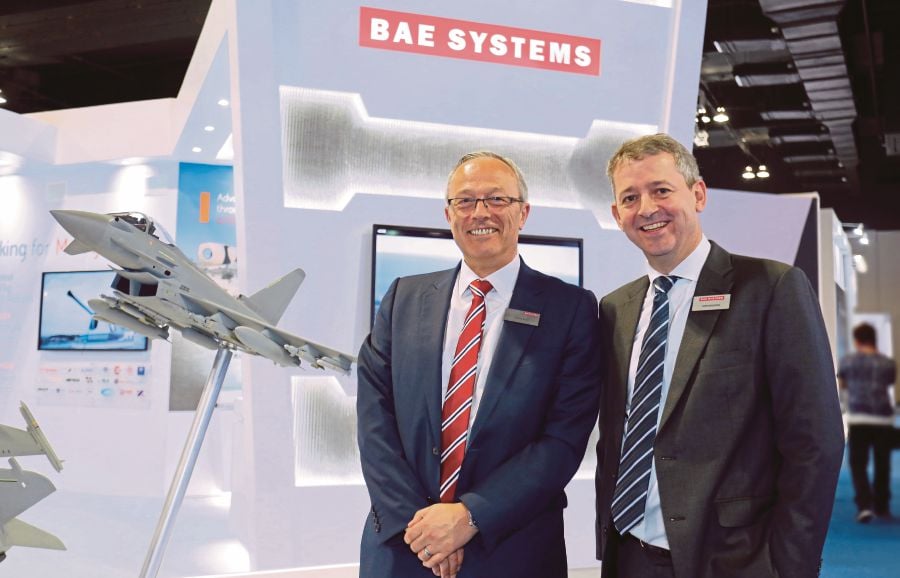
(L-R) BAE Systems International Sales Director – Typhoon and Hawk, Andy Lavin and BAE Systems International Ltd South East Asia Managing Director, John Brosnan with the Eurofighter Typhoon model at the BAE Systems stand at 16th Defence Services Asia 2018 in Kuala Lumpur. Picture courtesy of BAE Systems.
KUALA LUMPUR: BAE Systems Inc, the wholly owned US subsidiary of the British defence, security, and aerospace company BAE Systems PLC, is planning to set up a maintenance, repair and overhaul (MRO) facility and a vocational training centre in Malaysia.
BAE Systems International Ltd South East Asia managing director John Brosnan said the conditional assessment would be dependent on Malaysia’s decision to choose the company’s combat aircraft, Eurofighter Typhoon for Royal Malaysian Air Force (RMAF) multi-role combat aircraft (MRCA) programme.
“Both developments will be based on a joint-venture with local players. It will also provide economic value to the local market about five times of the value of the aircraft purchase,” he told NST Business in an exclusive interview yesterday.
Brosnan said the investment’s facility would be spent over 25 years, creating more than 20,000 high-skilled jobs for the locals including the establishment of vocational training centre for the local aerospace sector.
“We will develop the technical vocational training centre in phases over 10 years with the involvement of Bristol University and Loughborough University,” he added.
Brosnan said BAE Systems had been working with the RMAF for nearly five years to test its combat aircraft.
“Hopefully, a deal will happen soon for the Eurofighter Typhoon,” he said, adding that there is a requirement for Malaysia to upgrade its aerial surveillance capabilities.
Brosnan said the fighter jet delivery could be made in about four years, subject to the RMAF requirements and negotiations.
The fighter jet package could include the unit, support services including maintenance and repair as well as training modules for local technicians.
Malaysia has been for several years considering to replace its ageing combat fighters, Russian-made, MiG-29s, which currently are not in service.
However, the decision to acquire new 18 fighter jets has yet to materialise as the country is preparing its focuses on the 14th General Election, which will be held on May 9.
It was made to understand that the decision could only be finalised after the election with regards to potential purchase either Eurofighter Typhoon or France’s Dassault Aviation, Rafale fighter jet.
“Every country has economic pressure. Defence is a significant cost, where governments have to allocate certain spending priorities.
“That’s why we have affordable solutions whereby, rather than selling new defence equipment, we also help countries to upgrade their existing equipment with installation such as new missile system and radar,” said Brosnan.
However, he said there would come to a point where governments can’t just upgrade their defence systems.
“Malaysia is currently considering the replacement aircraft for its MRCA programme,” he opined.
He said Malaysia is certainly an important defence-military market in South East Asia for BAE Systems with over 50 years establishment in the country.
“We regard Malaysia as a first-world military customer. We are the largest international defence-equipment supplier to the Malaysian armed forces including frigates, trainer aircraft (Hawk), armed vehicles, missile systems, ground-based air-defence systems, radars and bridging systems,” he said.
BAE Systems International sales director – Typhoon and Hawk, Andy Lavin said the company provides the cheapest cost of ownership to operate the Eurofighter Typhoon.
“Currently we have over 520 units in service from eight countries including the United Kingdom, Germany, Austria, Saudi Arabia, Kuwait, Oman and Qatar.
“The fighter jet is collaboratively developed and manufactured by BAE Systems UK, Leonardo – Aircraft Division (Italy) and Airbus Defence & Space (Germany and Spain),” he said.
The Eurofighter Typhoon is a highly capable and extremely agile multi-role combat aircraft, capable of being deployed in the full spectrum of air operations including air policing, peace support and high intensity conflict.
“Currently we have secured over 100 additional orders with potential orders of 184 aircraft from countries including Germany, Saudi Arabia and Spain,” he said.
Lavin said Eurofighter Typhoon sales could reach 1,000 aircraft globally in the next five years, backed by on-going active campaign promotion in countries including Belgium, Finland, Poland, Switzerland, Bulgaria, Malaysia and Canada.
10 April 2018 By Azril Annuar And Ida Nadirah Ibrahim
Barisan Nasional youth supporters wave placards during the Barisan Youth Manifesto launching by Umno Youth chief, Khairy Jamaluddin at Merdeka Hall, PWTC, Kuala Lumpur, April 10, 2018. — Picture by Hari Anggara
KUALA LUMPUR, April 10 — Barisan Nasional’s (BN) manifesto for the youths launched tonight has eight pledges, chief among them to strengthen rural economies, guarantee more job opportunities, and increase income and training for young workers.
The creation of ‘agropreneur’ and ‘seapreneur’
To assist youths in rural areas, BN Youth chief Khairy Jamaluddin has promised to allocate RM180 million to fund young farmers, expected to benefit up to 10,000 “agropreneurs”.
Another RM20 million will be allocated to fund “seapreneurs”, affecting up to 1,000 young fishermen.
To create this new breed of rural youth entrepreneurs, he has promised to expand the rural digital economy through various programmes such as eUsahawan, eRezeki and eLadang while making it cheaper for youths to obtain a B2 motorcycle license under the MyLesen programme.
At the manifesto launch tonight, Khairy echoed BN chairman Datuk Seri Najib Razak’s promise to Felda settlers with a RM5,000 incentive for all, special replanting grant and to write off all replanting debts as well as debts incurred in purchasing Felda Global Venture shares.
In the manifesto, he said: “By assisting the youths in rural areas in every district, we will generate more job opportunities and guarantee that rural youths will succeed in the digital world. We will assist farmers and fishermen with funds and training programmes.”
One million jobs for youths
BN has also promised that youths will be able to take part in national infrastructure mega projects. He expected this to be able to generate more job opportunities as well.
More than one million youths will also benefit and be able to obtain career opportunities under Technical and Vocational Education and Training (TVET), as he plans on expanding the National TVET Boot Camp short courses and premises nationwide.
Another five million schoolchildren will be prepared with the relevant skill sets to face the Digital Industrial Revolution 4.0 while more than one million tertiary education students will be receiving PTPTN loans.
Khairy has also promised to create more high skill job opportunities by developing high tech industries and through MyInternship programme where university students have the opportunity to receive industrial training.
Boosting youth income
Young teachers can rejoice under BN’s leadership with the introduction of a special incentive if they hold tuition classes after school hours while reducing administrative duties.
Under the Fair Works Commission, Khairy promised to improve the market’s salary scale while increasing minimum wage.
He has also promised to reduce the nation’s reliance on foreign workers by 15 per cent. The ratio of employee compensation will also be increased up to 40 per cent of the national gross domestic product.
“We will begin to intervene on salary increment to improve the market’s salary scheme. We will also assist the youths to pick up new online skills or their productivity by assistance to purchase work related software.
“Companies are encouraged to offer flexible working hours and the youths have the opportunity to earn more income through the Orang-E portal,” he said in the manifesto.
Creating more youth entrepreneurs
BN will also allocated RM5 billion assistance into the Youth Entrepreneurial Network — a one-stop centre for all government agencies tasked with assisting young entrepreneurs. The network will reduce bureaucratic red tape while expediting approvals for assistance.
Tax exemption and a special fund will be granted to encourage renowned brands or companies to assist small time entrepreneurs while a digital transformation for the small and medium enterprises via grants and credit loan guarantee is expected to assist them gain access into the international market.
A special allocation for Sabah and Sarawak entrepreneurs will be made available under the National Development Fund where they will provide carve-out and compete initiatives.
Easing the burden of young families
Newly-wedded couples or those planning to get married will receive a financial assistance to ease wedding expenses.
A special parental course in 168 locations nationwide will also be made available for expecting parents while the existing ADAM50 initiative will increase the financial assistance for families with newborns.
Parents who save up for their children’s education will also enjoy a special incentive while children below 12 from low income families living in low cost housing schemes will have access to art and sports classes.
Micro-credit loan conditions specifically for part-time women entrepreneurs will be made available to encourage more women generate income.
Increasing quality of life
Like the main manifesto, affordable housing has received special attention from BN Youth. It has promised to increase the number of affordable homes, make rent more affordable, transit homes, rent-to-own homes and assisting them in getting deposits.
A special bank will be created to stimulate affordable home ownership. The bank will make loan processes for homes below RM300,000 easier.
Khairy also promised to reduce broadband subscription by 50 per cent while doubling its speed in phases. Public universities will be among the first to enjoy high speed internet access of 100 gigabit per second.
Under BN’s rule, each state constituency will enjoy a public internet centre with a minimum speed of 20 megabit per second.
No one left behind
To ensure that everyone will enjoy Malaysia’s economic success, Khairy has given his guarantee to a broad segment of Malaysian society that has been left behind and forgotten.
Islamic religious school graduates will be paired up with Halal Industry Companies while the Orang Asli youths will have job opportunities with green companies. Training will also be provided for disabled youths so they may enter the mainstream job market.
Former drug abusers, former juvenile convicts, the homeless and single teen mothers will also be granted a second chance through training programmes so they too may enter the mainstream job market.
Youth participation in national administration
Youths will also be able to decide on national and local agenda. Khairy promised to establish a Youth Local Council chaired by the local council presidents or mayor so they may debate issues pertaining to youths.
He also promised a 35 per cent youth participation on Rukun Tetangga leadership committees while under the Belia@Kabinet programme, the best ideas from youths voted under the MyCadang application will be submitted to the Cabinet on a monthly basis.
Datuk Seri Najib, dalam ucapan perasmiannya berkata, ini merupakan tambahan kepada tiga juta peluang pekerjaan yang dijanjikan sewaktu pelancaran Manifesto Barisan Nasional pada 7 April lepas. – Astro AWANI/SHAHIR OMAR
KUALA LUMPUR: Program MyApprenticeship, yang dilancarkan Perdana Menteri Datuk Seri Najib Tun Razak hari ini dijangka dapat menambah sejuta lagi peluang pekerjaan dalam bidang-bidang seperti automotif, pengkomputeran, termasuklah Revolusi Perindustrian Keempat atau IR4.10.
Najib, dalam ucapan perasmiannya berkata, ini merupakan tambahan kepada tiga juta peluang pekerjaan yang dijanjikan sewaktu pelancaran Manifesto Barisan Nasional (BN) pada 7 April lepas.
“Ternyata ini sungguh berbeza dengan manifesto pembangkang yang hanya sekadar menjanjikan satu juta sahaja peluang pekerjaan dalam tempoh lima tahun yang sama,” katanya sewaktu merasmikan Program MyApprenticeship di Pusat Dagangan Dunia Putra (PWTC) di sini hari ini.
Melalui program itu, Kementerian Sumber Manusia dan Kementerian Kewangan akan bertindak sebagai peneraju, dan satu juta peluang perantisan akan disediakan di sektor awam dan swasta, dengan sasaran mereka ialah golongan belia dan wanita di negara ini.
Perdana Menteri berkata, beliau yakin penyediaan tambahan sejuta lagi peluang pekerjaan itu dapat direalisasikan berdasarkan konteks dan kerangka ekonomi Malaysia yang semakin kukuh dan mantap.
“Salah satu daripada perkembangan termasuklah apabila Forum Ekonomi Dunia (WEF) baru-baru ini telah mengangkat Malaysia kepada dua anak tangga, dan kini kita berada di kedudukan ke-23 daripada 137 buah negara paling berdaya saing di persada global.
“Bang Dunia pada tahun lepas juga telah menaikkan unjuran ekonomi Malaysia sebanyak tiga kali, dan mereka telah menutup dengan jangkaan ekonomi kita berkembang pada kadar 5.8%. Dan meskipun diulangkaji sebanyak tiga kali, kita telah mengatasi unjuran tersebut apabila kita berjaya mencapa pertumbuhan sebanyak 5.9 peratus,” katanya lagi, selain menyebut tentang penarafan positif dari firma antarabangsa seperti Moody’s, Standard and Poor, dan Fitch yang meletakkan Malaysia pada kategori A.
Perdana Menteri juga berkata bahawa beliau telah dimaklumkan satu lagi perkhabaran gembira apabila Bursa Saham Malaysia hari ini telah mencecah paras yang tertinggi dalam sejarah.
“Ini semua menafikan dan menolak apa yang diwar-warkan oleh pembangkang kononnya Malaysia ini adalah negara bankrap atau failed state, mahupun perlu diselamatkan. Rekod pencapaian kita seperti ini bukan perlu diselamatkan, tapi kita perlu menyelamatkan negara kita daripada jatuh ke tangan mereka yang tergolong dalam kumpulan tersebut,” katanya lagi.
Mereka yang ingin mengetahui lebih lanjut mengenai program MyApprenticeship ini boleh melayari www.myapprenticeship.my, sebuah portal yang bertindak sebagai one stop platform dalam menyediakan maklumat mengenai peluang perantisan, peluang pekerjaan termasuk memadankan program perantisan dengan majikan yang bersesuaian mengikut bidang pekerjaan.