AVOID BEING FOOLED BY COLLEGES IN MALAYSIA!

Well, this was shared by one of my friend in the IPTS.

“Don’t get fooled by fake promises and offers, especially 2016 SPM Leavers and their parents!.

Misleading information such as Bantuan Kementerian Sumber Manusia, Peluang Ke Pengajian Tinggi, Diploma Kerajaan are very viral since the release of SPM results yesterday.

Please verify with the relevant authorities or consultants before making any decision. What you should know before choosing a college? Check for this basic 5 points as listed below!

1. Check whether they are registered with Ministry of Higher Education! There are some irresponsible parties offering diplomas and skills certificate without the approval from MOHE or DSD. There are cases of non genuine courses offered to the public under the name of Professional Diploma and Executive Certificate. So please stay alert folks.

2. Minimum entry requirement for a diploma programme which is accredited by MQA differs depending on the field of the programme. Exp:- Any hospitality related courses requires the candidates to obtain a pass in their SPM with minimum 3 credits. Skills certificates such as SKM requires a minimum age of 16 to enroll. So when it said Diploma, check for this details. If it is stated that minimum age of 16 and 3M as the requirements, it is Skills Certificate programme under the Department of Skills Development.
For the listing of DSD (or JPK in BM) Accredited Training Providers & their programmes, kindly search here

3. Are the courses fully accredited or still under provisional accreditation? You can check this by simply looking at their course code. Full accreditation will have the alphabet beginning with A*** and Provisional Accreditation will reflect PA at the beginning of the code. What is the meaning? PA is given to any new course that is approved by MQA to be offered in the institution. The college or institution need to be accessed again after 2 years of provisional period by MQA. If MQA feels that the college has met the minimum requirements and programme standard, the college will be given Full Accreditation. It is something like from a ‘P’ to Full driving license process.

4. Know your sponsor or financial assistance providers:-
PTPTN – provide loan for IPTA & IPTS programmes
PTPK – provide loan for JPK programmes

5. Compare the course structure!
Please ensure that relevant subjects are offered in the programme. Evaluate whether the subjects offered are industry based or competent. It is good to have a balance study of 50% theory and 50% practical. Rather that choosing Diploma in Business Management, consider joining Diploma in Baking Science or Diploma in Culinary or Diploma in Entrepreneurship. For an example:-

Course offered at MIB College:

Diploma in Baking Science & Technology. Apart from baking and food related subjects, the students are required to take subjects like Economics, Accounting, Marketing, Human Resource Management, Operations Management, Financial Management, Cost Accounting, Business Maths and many more!

So try putting yourself in the employers shoes and ask yourself. Do you prefer baking graduate or business graduate? Do you prefer students with merely paper based qualification or equipped with some hands on practical skills?

Remember! One of the reason for unemployment is lack of industrial competency of the graduates.

College, industries sign MoU to promote technical education

Sahran (left) exchanges the MoU documents with a representative of 28 TVET-related industry players, witnessed by Fazzrudin (second left) and Zainuren. — Photo by Muhammad Rais Sanusi

KUCHING: Kolej Vokasional Matang has reached another milestone with the signing of a memorandum of understanding (MoU) aimed at establishing partnership with 28 local industries and intensifying the development of highly-skilled students.

Education Ministry’s technical education and vocational training (school division) director Zainuren Mohd Nor said the MoU was vital as it encouraged the sharing of expertise and technology between industry players and the college, as well as to promote technical education.

According to him, the government realises the importance of technical and vocational education and training (TVET)-related skills in order to attain the ‘First World’ country status by 2020.

Statistics have shown a low turnout of students in the country pursuing technical education – constituting only seven per cent out of the total number of students.

However, society now realises the importance of TVET. It is estimated that 1.6 million jobs would be created across all economic corridors throughout the nation by 2020.

“Our country is still far behind in terms of technical education and vocational training compared with other developed countries. One of the factors is the lack of interest among students in technical courses.

“It is hoped that in years to come, more students would opt for technical education and vocational training in order to secure a better future with high salaries,” he said at the MoU signing ceremony between Kolej Vokasional Matang and the 28 TVET-related industries at Yayasan Sarawak auditorium here yesterday.

Moreover, Zainuren disclosed that under the Vocational Education Transformation Plan, the expectation for TVET students would be for 70 per cent of them to become skilled workers, 20 per cent to further their studies, and 10 per cent to become entrepreneurs.

Tupong assemblyman Fazzrudin Abdul Rahman and Kolej Vokasional Matang director Mohamad Sahran Amin were also present at the function.

Source: 

Kerajaan isytihar 2017 tahun TVET – Ke Arah Negara Berpendapatan Tinggi

RIOT: Kerajaan telah mengisytiharkan 2017 sebagai Tahun TVET dalam usaha mencapai status negara berpendapatan tinggi menjelang 2020.Kerajaan isytihar 2017 tahun TVET - Riot

SHAH ALAM: Kerajaan telah mengisytiharkan 2017 sebagai Tahun Pendidikan Teknikal dan Latihan Vokasional (Tahun TVET) dalam usaha mencapai status negara berpendapatan tinggi menjelang 2020, kata Menteri Sumber Manusia Datuk Seri Richard Riot Jaem.

Beliau berkata inisiatif itu juga seiring dengan ucapan Perdana Menteri Datuk Seri Najib Tun Razak semasa membentangkan Bajet 2017 bahawa keupayaan TVET akan dipertingkatkan di bawah bajet tersebut.

“Walaupun perkara ini tidak diumumkan secara rasmi sebelum ini, kalau kita nampak pada ucapan Najib dalam Bajet 2017 tempoh hari, perkataan TVET ditekankan.

“Ini bermakna, dengan penekanan ini, secara langsung dan tidak langsung, TVET menjadi permulaan kepada usaha kerajaan untuk lebih gigih dalam melahirkan ramai modal insan berkemahiran,” katanya pada sidang media selepas penyerahan akreditasi kepada Proton Holdings Berhad sebagai pusat sehenti untuk program Sistem Latihan Dual Nasional, di sini pada Khamis.

Datuk Seri Richard Riot berkata untuk mencapai status negara maju berpendapatan tinggi, tenaga kerja berkemahiran tinggi diperlukan dan setakat ini hanya 28 peratus modal insan. Malaysia merupakan pekerja berkemahiran dan kerajaan menyasarkan untuk mencapai sekurang-kurangnya 35 peratus menjelang 2020.

Dalam perkembangan lain, beliau berkata Majlis Ekonomi Negara telah meluluskan cadangan Skim Insurans Pekerjaan (EIS) bagi membantu pekerja yang diberhentikan dan usul akan dibentang di Parlimen pada Januari 2018.

Sebelum ini, menteri itu dilapor berkata skim yang memperuntukkan sumbangan majikan dan pekerja itu amat penting untuk memastikan pekerja yang diberhentikan mampu menyara hidup sekurang-kurangnya selama empat bulan sebelum mendapat pekerjaan baharu.

Terdahulu, Datuk Seri Richard Riot menyampaikan Diploma Lanjutan Kemahiran Malaysia kepada 30 penerima selain menyaksikan pemeteraian memorandum persefahaman (MOU) antara Proton dan Jabatan Pembangunan Kemahiran (JPK)  bagi program pembangunan jangka panjang pekerja berkemahiran.

Pada majlis itu, 27 individu menerima biasiswa Yayasan Proton untuk menyambung pendidikan peringkat Sijil Kemahiran Malaysia.

– BERNAMA

Freeze hurting our agriculture – Labour shortage issues

Cause and effect: Prices of vegetables and poultry are expected to keep increasing due to manpower shortage at the farms.

PETALING JAYA: The freeze on foreign labour is hurting the local agriculture industry here with livestock farmers claiming that the industry will be crippled within a year if nothing is done.

Federation of Livestock Farmers’ Associations Malaysia president Datuk Jeffrey Ng said consumers would have to pay more for imported meat because local farms would be forced to close down due to the lack of workers.

“We do not want this to happen,” he said.

Stressing that many farms were struggling to keep up with production to meet market needs, Ng said he was not optimistic of the situation getting any better.

“I do not know how long we can sustain because the workers are leaving gradually after their contracts end,” he said.

Ng said claims that foreign workers contributed to social and security problems could not be applied to the livestock industry because the farms were mostly away from the cities.

“Our workers eat and stay at the farms.

“They do not get their weekly off days like others, so they can hardly leave their work place,” he said.

He pointed out that the industry was facing a shortage of at least 8,000 workers.

“We are not asking for more but to replace those whose contracts have expired,” he said.

In Johor Baru, the state’s Small and Medium Poultry Farmers Association president Lim Ka Cheng said farmers and businesses had voiced out their concerns over the shortage of foreign workers.

“Johor usually supplies some 10 million dressed chickens and eight million eggs each month but production has dropped by some 20% since early this year.

“We are the top producer of chickens and eggs in the country, contributing 30% of the overall supply while 10% of the production is exported to Singapore,” he said.

Lim said during the recent meeting with the Federation of Malaysian Vegetable Farmers Association, Malaysian Mushroom Research Association and Malaysian Fruit Farmers Association, it was highlighted that the shortage of workers was at a “very worrying stage”.

“The Government’s policy has posed a huge challenge for us as foreign workers cannot extend their contracts nor can business owners bring in more foreign labour to work at farms and sites,” he said when contacted.

He said the production sector would be affected if the problem was not resolved soon.

Lim said locals stayed away from such jobs and the association’s 300 chicken farmers needed foreign workers to maintain the hygiene of the farms and processing plants.

 Source: The Star Online

Comments: Should reconsider previous implementation of an induction course for the foreign workers to attend, learning about our culture, language & law. Perhaps that may lead to lower social & security problems. Or is that just an excuse by the government to make way for locals to be employed (but yet the low skill & low knowledge locals still avoid these jobs?)

Malaysia’s skilled workers shortage – what it means to the economy

Skilled labour shortage very serious, says minister | The Star

More trained workers needed to attract new capital investments

THE Malaysian economy can sure use a boost to grow sustainably in the long term because the indicators for long-term growth do not look very good.

That boost should come from a focus on human capital. To put it simply, a better proportion of skilled workers is needed for the economy to move up the value chain and be globally competitive.

This year the economy is expected to grow just over 4% year-on-year, after growing 5% last year and 6% in 2014. The economy is expected to grow by 4% to 5% next year although the headwinds buffeting the Malaysian economy will make it challenging to hit the upper band of the target.

Moving up the chain will mean producing goods and services that have a higher value, meaning that productivity will rise. The rise in productivity will mean that workers will get better wages. This is the basic argument of policymakers when they speak of how human capital can help the economy.

However, the reality is different. According to data from the Malaysian Productivity Corp, the average annual labour productivity growth between 2011 and 2015 was 1.8% while the 11MP has a target of 3.7% annual growth. The doubling in labour productivity growth is needed to hit the high-income target of the New Economic Model.

Malaysian Employers Federation executive director Datuk Shamsuddin Bardan notes that the economy saw a labour productivity growth of 3.3% last year but believes that it will be challenging for labour productivity to grow in the years to come because of the lack of skilled workers@skilled workers shortage. 

Yap says manufacturers have to source for high-quality technology from places such as Europe and Taiwan to upgrade their production processes.

The 11MP targets skilled workers, that is, those with diplomas and higher qualifications, to reach 35% or 5.35 million of total workforce by 2020. Currently 28% of the total workforce of 14.76 million are considered skilled workers.

Shamsuddin fears that without more skilled workers, the economy will find it more difficult to move up the value chain and will not be able to attract large capital investments.

He tells StarBizWeek that the 11MP target is well below the proportion for skilled workers compared to developed economies, where the proportion is at least half of the total workforce.

Shamsuddin says government plans to raise the skill levels of Malaysian workers have so far only shown mixed results, with a gap between the plans and the actual implementation.

Indeed, the Organisation for Economic Cooperation and Development, a grouping of rich economies, says in a 2013 report that the country needs to address long-standing economic weaknesses in the medium term in order to progress toward becoming an advanced economy within the next decade.

“Skill shortages and mismatches and the deficiencies in the education system that underlie them and the low participation of women in the workforce particularly need to be remedied,” it says.

It adds that the talent base of the workforce lags behind the standards of high-income nations. “The country suffers from a shortage of skilled workers, weak productivity growth stemming from a lack of creativity and innovation in the workforce, and an over-reliance on unskilled and low-wage migrant workers,” it adds.

Observers say cheap unskilled foreign labour is the bane of the Malaysian economy. According to the latest official estimates, there are 1.9 million documented foreign workers in the country with the Government having put a cap of the proportion of foreign workers to the total labour force at 15%.

Unofficial estimates of foreign workers, both legal and illegal, could be more than double that with the numbers having a negative effect on total wages.

Socio Economic Research Centre executive director Lee Heng Guie says in the long run, businesses will need to increase automation for the low-value processes in the manufacturing sector in order to reduce their reliance on foreign labour.

Shamsuddin: ‘I doubt very much whether our policy emphasising English will be successful, as statistics indicate that if we ask teachers themselves to take SPM English exam, possibly half of them will fail.’

“We are not asking everything to be automated as some places you still need labour, but what you want is to gradually move up rather than continue to rely on cheap labour.

“It is not a solution for industries to compete,” he says. There is also a need to review policies in order to identify implementation flaws and weaknesses.

But the work cannot be all one-way. Lee points out that the private sector must come forward to work with the Government to create a sustainable ecosystem for innovation.

While businesses acknowledge the urgency of working efficiently and relying less on foreign workers, they point out that the supporting technology including for automation cannot be found in the country and must be sourced from abroad.

Asia Poly Industrial Sdn Bhd executive director Michael Yap says manufacturers have to source for high-quality technology from places such as Europe and Taiwan to upgrade their production processes. The company, a subsidiary of Bursa-listed Asia Poly Holdings Bhd, is a maker of cast acrylic sheets used to make corporate signages, lighting displays and sanitary ware, has a high proportion of foreign workers in its workforce.

Yap also finds it difficult to get skilled workers or even motivated ones compared to the 1980s and 1990s. He says engineers today are not willing to take up challenges and many graduates cannot solve problems.

His colleagues observe that Malaysians also do not want to work in the manufacturing sector, even if the workplace environment is conducive and they are given opportunities to give their inputs.

Given the increasing importance of the services sector to the economy, English-language skills are important but again, there is a gap between the plan and the implementation.

The Services Sector Blueprint launched last year targets the sector to make up 56.5% of gross domestic product by 2020.

Shamsuddin says it is critical for the education system to plan for the future requirements of the economy and the command of English is very important to the services sector.

“I doubt very much whether our policy emphasising English will be successful, as statistics indicate that if we ask teachers themselves to take SPM English exam, possibly half of them will fail,” he adds.

Lee feels that a more consistent policy towards English is important, referring to the abrupt change in the teaching of mathematics and science to Bahasa Malaysia after it was taught in English from 1996 to 2012, as a change that has failed Malaysian children.

Sorce: The Star.com.my

Anda lepasan KV/pemegang Diploma/Ijazah bidang teknikal? Boleh ambil VTO?

Lepasan KV boleh ambil VTO?

Ya, jika anda lepasan KV dan pemegang diploma/ijazah bidang teknikal, boleh ambil VTO. Namun, pra-syaratnya (mulai 1/1/19) adalah perlu ada Sijil Kemahiran Malaysia (SKM) Tahap 3 bidang kemahiran/teknikal.

Sekiranya anda ada DVM, Diploma atau Ijazah akademik, anda akan layak jadi TENAGA PENGAJAR & juga PEGAWAI PENGESAH DALAMAN (walaupun tanpa Sijil Kemahiran Malaysia tapi kena ada sijil induksi PP-PPD-PPB).

Sekiranya anda ambil VTO, anda layak dilantik sebagai Pegawai Penilai (PP)

Cuma pastikan bidang kelayakan anda tu sudah ada dalam Daftar NOSS supaya anda dapat jalankan internship (praktikal mengajar di Pusat Bertauliah JPK awam/swasta) selama 6 bulan setelah habis kursus teori.

Kepentingan Pengetahuan Mengenai Pegawai Penilai dan Tenaga Pengajar

  1. Paling penting sekali, anda tahu apakah kriteria lantikan PP dan TP supaya tidak silap mengikuti kursus dan membazir wang dan masa mengikutinya!
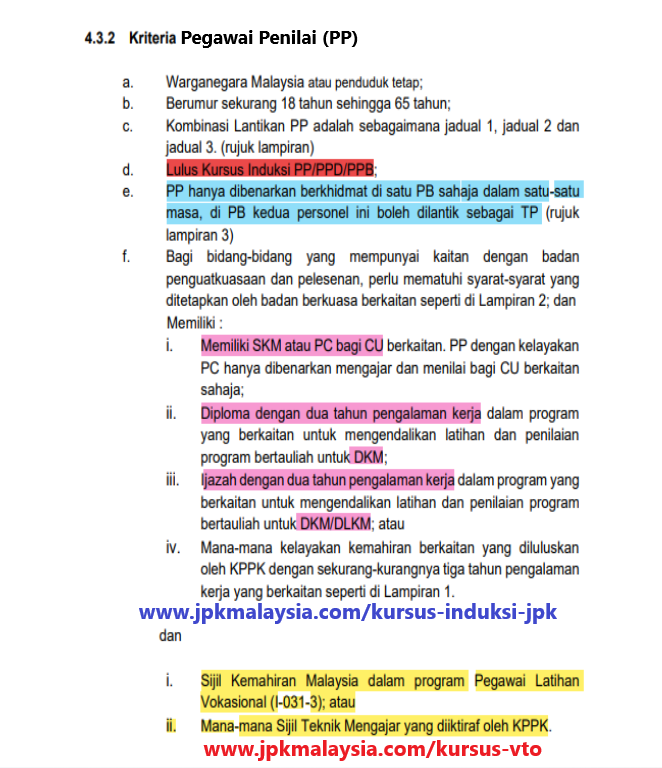
PP vs TP: Kritiria Lantikan PP
PP vs TP: Syarat Kelayakan PP
PP vs TP: Kriteria Lantikan TP

a) Dari 3 jadual di atas, jelas menunjukkan kedua-dua PP dan TP WAJIB lulus kursus induksi PP/PPD/PPB.

b) Dari segi pemilikan Sijil Kemahiran Malaysia (SKM), Diploma Kemahiran Malaysia (DKM) atau Diploma Lanjutan Kemahiran Malaysia (DLKM), adalah TIDAK WAJIB untuk TP tetapi WAJIB untuk PP.
Sekiranya anda ada pengalaman kerja dalam bidang kemahiran anda (> 3 tahun ke atas secara amnya) tetapi masih tiada SKM lagi, bolehlah mohon SKM secara PPT (Berdasarkan pengalaman kerja & bukti ketrampilan, tak perlu ikuti kursus berbulan/tahun lamanya)

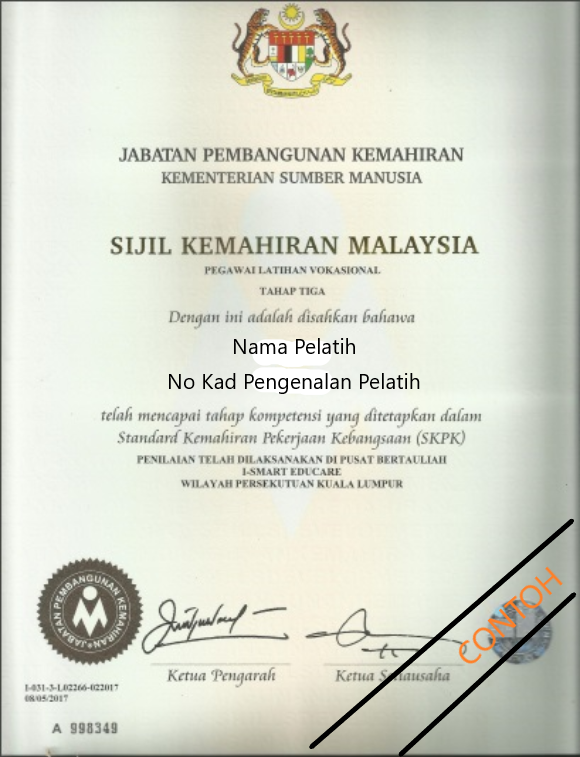
c) Juga, PP WAJIB ada Sijil Pegawai Latihan Operasi/Vokasional (I-031-3:2014) @ VTO (yang merupakan syarat asas lantikan sebagai Pengajar Vokasional) atau Sijil Teknik Mengajar yang diiktiraf oleh JPK (rujuk jadual di bawah).

Kursus-Kursus Untuk Melayakkan Anda Sebagai Pegawai Penilai (Selain SKM)

1) Kursus VTO
Pengambilan akan datang: bulan Nov/Dis, akan ditentukan kemudian mengikut bilangan calong.

2) Induksi PP-PPD-PPB
Tarikh: 8-9 Oktober di Kepong Metro Prima (sekiranya anda di negeri lain yg jauh, tolong maklumkan, mungkin ada alternatif). Sila rujuk Jadual Kursus Induksi Terkini dari sini.
Tarikh tutup: 30 Sept

Jika ada pertanyaan lanjut, sila hubungi 03-27819937 atau 012-3123430.

Lepasan KV boleh ambil VTO
Lepasan KV boleh ambil VTO -Identifying WA

Mengapa ambil VTO? Kelayakan Pegawai Penilai (PP)

kelaykan pegawai penilai

Apakah Kelayakan Pegawai Penilai?

Kebelakangan ni, saya menerima banyak pertanyaan dari calon yang berkelayakan diploma/ijazah (bidang teknikal) samada mereka layak ikuti kursus VTO. Tujuan utama mengambil VTO adalah supaya boleh dilantik sebagai Pegawai Penilai di Pusat Bertauliah JPK – salah satu kelayakan Pegawai Penilai (walaupun ada yang perlukannya untuk mengajar secara kontrak di agensi-agensi kerajaan tertentu). Berikut adalah kriteria perlantikan Pegawai Penilai.

Kriteria

a. Warganegara Malaysia ;
b. Berumur sekurang-kurangnya 18 tahun;
c. Berkhidmat di satu PB sahaja;
d. Lulus Kursus Induksi PP/PPD/PPB (dianjurkan oleh I Smart Educare setiap 2 bulan, sesi seterusnya adalah seperti berikut:

1) Tarikh: 6-7 Ogos 16
Tempat: Kepong, KL)

2) Tarikh: 13-14 Ogos 16
Tempat: Gambang, Kuantan. Bagi bidang-bidang yang mempunyai kaitan dengan badan penguatkuasaan dan pelesenan, perlu mematuhi syarat-syarat yang ditetapkan oleh badan berkuasa berkaitan;

dan

f. Memiliki :
i. SKM3 dalam program yang berkaitan pada satu tahap yang lebih tinggi atau tertinggi untuk mengendalikan penilaian program bertauliah bagi program tahap 1 dan tahap 2;
ii. SKM/DKM/DLKM dalam program yang berkaitan pada tahap yang sama atau lebih tinggi untuk mengendalikan penilaian program bertauliah bagi tahap 3 ke atas;
iii. Diploma dengan dua tahun pengalaman kerja dalam program yang berkaitan untuk mengendalikan latihan dan penilaian program bertauliah untuk DKM;
iv. Ijazah dengan dua tahun pengalaman kerja dalam program yang berkaitan untuk mengendalikan latihan dan penilaian program bertauliah untuk DKM/DLKM; atau
v. Mana-mana kelayakan kemahiran berkaitan yang diluluskan oleh KPPK dengan sekurang-kurangnya tiga tahun pengalaman kerja yang berkaitan.
 
dan
 
i. Sijil Kemahiran Malaysia dalam program Pegawai Latihan Vokasional (I-031-3); atau

ii. Mana-mana Sijil Teknik Mengajar yang diiktiraf oleh KPPK.

Pengambilan VTO akan datang:  

Tarikh mula: 20hb Ogos (setiap Sabtu)
Tempoh: 6 bulan
Internship: 6 bulan (mula selepas 6 bulan kelas teori & lawatan PPL) di Pusat Bertauliah pilihan anda yang menawarkan program kemahiran bidang andaUntuk urusan pendaftaran, sila emel ke ismarteducare@gmail.com atau hubungi pejabat di 03-62429999 atau Melvin di 012-3123430.

Khairy: Public perception of vocational education has improved

Khairy with Malaysian Youth Council- 1Belia 1Kemahiran graduates at their convocation ceremony in Putrajaya. - Bernama

Khairy with Malaysian Youth Council- 1Belia 1Kemahiran graduates at their convocation ceremony in Putrajaya. – Bernama

PUTRAJAYA: The perception towards technical and vocational education and training (TVET) in Malaysia has improved over the past few years, and is no longer seen as a “last option” in career choices, says Khairy Jamaluddin.

The Youth and Sports Minister said the public has grown to realise the potential of TVET due to its importance to a developing nation and its high employability level.

“In conjunction with the 2010 National Youth Day, the Malaysian Youth Council launched the 1Youth 1Skill (1B1K) programme to help youths get involved in skills training programmes and select TVET as a career choice.

“At that time, society’s perception was that TVET is only for those who didn’t complete Form Five, those who were expelled from school or those who have been sent for juvenile rehabilitation.

“But today, the public have changed their mindset towards TVET. They do not see it as a second or last option in one’s career choice.

“People acknowledge that products of technical and vocational education are highly employable and have an easier career path.

“The Government recognises TVET graduates as assets to the country that we can be proud of.

“Graduates of the National Youth Skills Institute today have a 90% employability rate, which means nine out of 10 graduates will definitely get a job.

“Compare this to degree holders, who cannot land a job after graduating. Why? It’s because their courses are not tailored to the demands of the industry.

“Those who pursue TVET in Malaysia are assured that their training is in line with what the industry wants,” said Khairy in his speech at the fourth 1B1K convocation on Tuesday.

He said Malaysia should emulate developed countries like Germany, Japan and South Korea where TVET is given top recognition.

“These are countries that are more developed than Malaysia and are well-advanced in technology, ahead of others. They make TVET a priority in their education system.

“In Germany, nearly 60% of the students are in the vocational and technical stream. The country’s economy and advances in automative technology are spearheaded by the successes of TVET graduates.

“Malaysia should emulate these countries. And that is why the Government has invested a lot in TVET. The last budget saw RM1bil allocated to enhance the quality of TVET,” said Khairy.

He said 4,967 youths have received skills training at public and private institutes since the 1B1K programme was launched.

About 500 youths received their certificates at the convocation ceremony.

Source: The Star Online, 10th May 2016

Mahdzir: Malaysia TVET programmes leading in region

TVET

KUALA LUMPUR: Malaysia is at the forefront of Technical and Vocational Education and Training (TVET) in the Asia-Pacific region with three local vocational learning institutes accredited the Gold level.

Education Minister Datuk Seri Mahdzir Khalid said the three institutes awarded the Asia-Pacific Accreditation and Certification Commission (APACC) were Politeknik Ungku Omar, Politeknik Sultan Salahuddin Abdul Aziz Shah, and Politeknik Sultan Ibrahim.

“This is a testimony of the quality of our TVET programmes which has gained international recognition in terms of standards that are comparable to other countries in the region,” Mahdzir said at the Asia-Pacific Education and Training Conference (ACET) in Berjaya Times Square Hotel today.

Despite the international recognition, he said, people still perceive vocational training as less desirable than pursuing higher academic learning.

Mahdzir said Malaysia under the Economic Transformation Programme (ETP) will require 2.5 times more TVET enrollment by 2025 but there is currently a shortage of such graduates.

“Currently, TVET programmes do not necessarily attract students with stronger academic qualifications. This could be due to a perception that TVET qualifications offer less attractive career and academic progression,” he said.

As such, he added, the National Education Blueprint 2015-2025 aims to promote vocational and skills training as a parallel path to success along with higher education.

Among the efforts undertaken by the Education and Higher Education Ministries are letting the industry design the curriculum in vocational schools, introducing apprenticeship, hands-on training, real-life simulations, and employer training programmes.

Another is to enhance coordination across the Ministry’s various TVET providers to eliminate redundant programmes, to provide greater specialisation in areas of expertise and improve cost efficiency.

Mahdzir added that TVET is one of Malaysia’s success stories and the ACET provides a platform for other countries to learn from it.

Source: Borneo Post Online, 1st May 2016

SVM made equivalent to spm with 3 credits

PUTRAJAYA: The Education Ministry has announced that the Sijil Vokasional Malaysia (SVM) is equivalent to a Sijil Pelajaran Malaysia with three credits.

In a statement yesterday, Education director-general Datuk Seri Dr Khair Mohamad Yusof said the equivalent was for candidates who obtained the

academic Cumulative Grade Point Average (CGPA) similar or better than 3.33, with credit in Bahasa Melayu SVM Code 1104 and the Vocational CGPA similar or better than 3.67 with competence in all vocational modules.

“Through the equivalent, Sijil Vokasional Malaysia students are eligible to further their studies to Diploma Vokasional Malaysia at Vocational Colleges, as well as obtain the Sijil Kemahiran Malaysia to the highest level at Level 4.

“Apart from that, students are also eligible to continue their studies at public and private tertiary level using the SVM which had been given equivalent recognition.

“Students can also choose to improve their skills to a level higher via higher institutions of skills training,” he said.

Khair said the Vocational Education Transformation was one of the efforts to provide education opportunities to all. — Bernama

Read more: http://www.theborneopost.com/2016/03/24/svm-made-equivalent-to-spm-with-3-credits/#ixzz44DOG784E