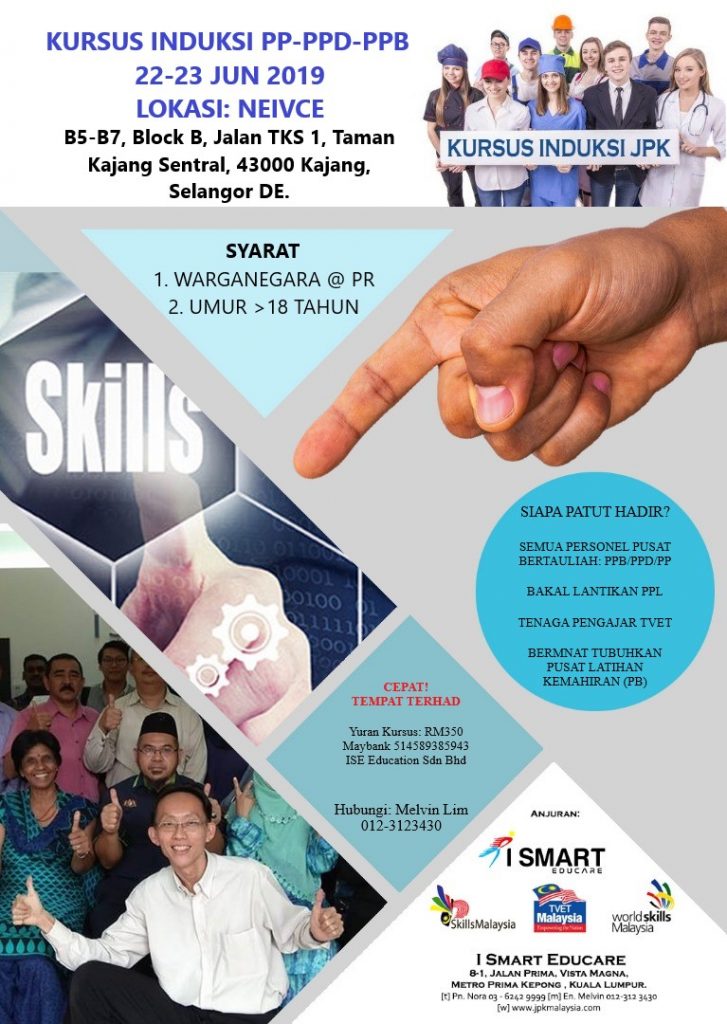
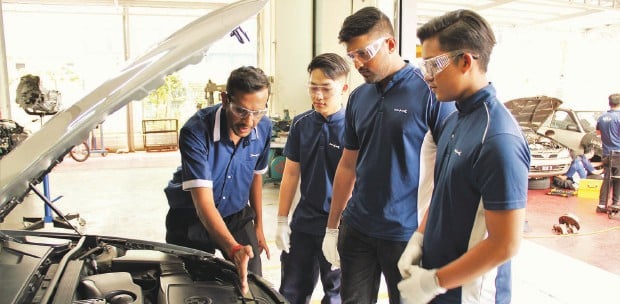
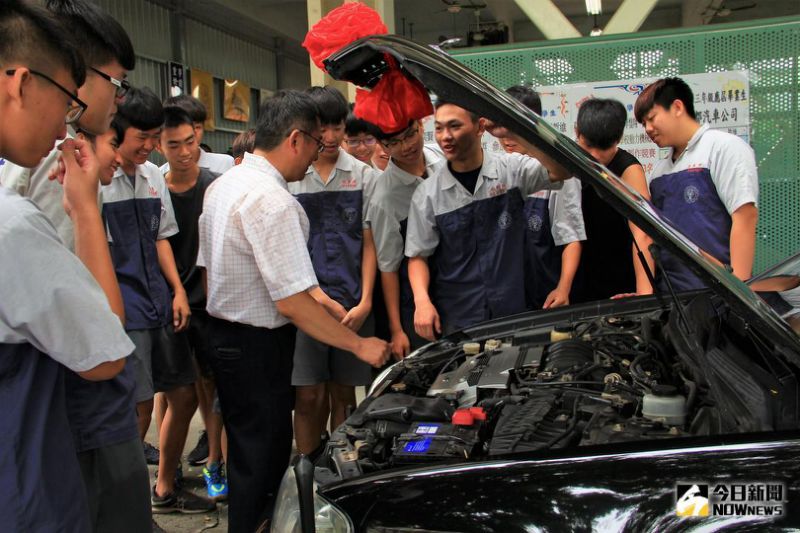
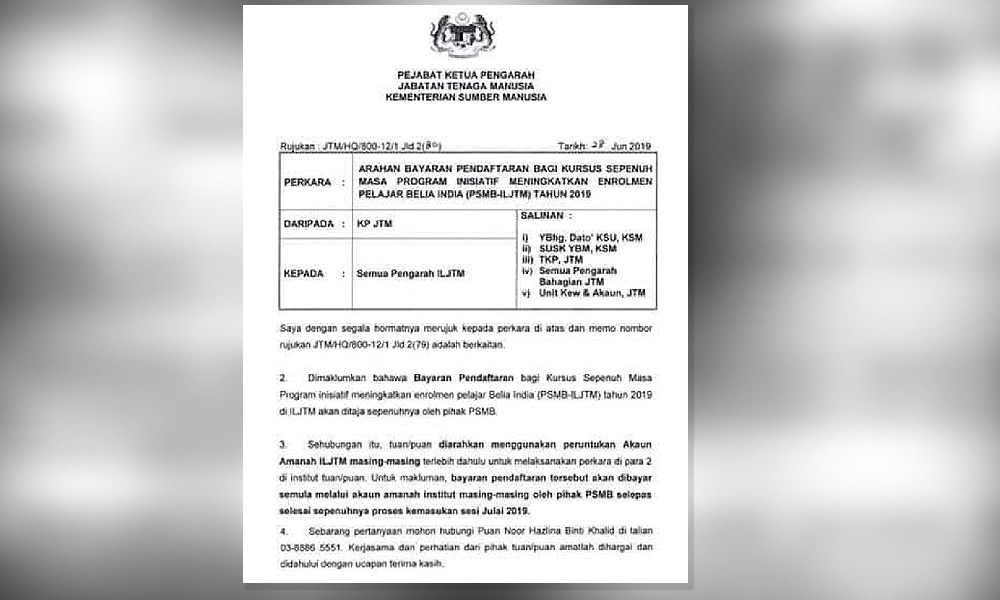
The technical and vocational education training (TVET) for Indian participants at a Johor training centre is being funded by a trust for Indian Malaysians that has been in existence since 2013, says the Human Resources Ministry.
The ministry was responding to criticism that alleged only Indian participants received fee exemptions.
In a statement today, the ministry said the exemptions are for diploma and certificate courses, and added that it is also working to expand the exemption to the B40 group and Orang Asli participants.
Earlier today, Parti Bumiputera Perkasa Malaysia (Putra) highlighted that some parents who sent their children to the Industrial Training Institution in Johor had vented their frustration over Indian students being purportedly exempted from paying fees.
In a statement, the party accused the Human Resources Ministry of abusing its power and misusing public funds for race-based purposes.
The Human Resources Ministry said, meanwhile, that RM5 million was allocated in Budget 2019 to encourage up to 2,000 Indian youths to choose TVET courses.
As of July 1, some 356 Indian youths had enrolled in short-term courses, and the ministry is expecting 218 more to enrol in diploma and certificate courses for the July 2019 session.
The ministry pointed out that this is not the first time an initiative for Indian youths has been implemented.
It said the Youth and Sports Ministry allocated RM11.6 million from 2013 to 2015 for a TVET initiative which involved 671 Indian students.
Source: www.malaysiakini.com
Comment: All communities should not be left out in the opportunity for education in Malaysia, especially the B40 group. There are certain extremist group in social media & NGO that’s trying to create hatred among the Malays towards other races in Malaysia, as well as portraying that the current PH government is incapable by specifically targeting some Ministers. DO NOT MIX education with race & politics!
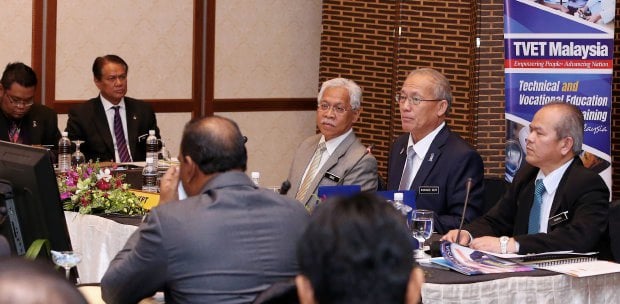
Datuk Mahfuz Omar said an amendment to the Employment Act 1955 is being prepared and will be submitted to the Cabinet before it is tabled in Parliament. ― Picture by Miera Zulyana
KUALA LUMPUR, June 20 — The Human Resource Ministry plans to introduce a three-day paternity leave for the private sector, in response to requests from NGOs and private sector unions, Deputy Minister Datuk Mahfuz Omar said today.
He said an amendment to the Employment Act 1955 is being prepared and will be submitted to the Cabinet before it is tabled in Parliament.
“We have held discussions with the National Labour Advisory Council and representatives of trade unions and employers on the matter,” he told a press conference after a Clients Day programme of the Skills Development Fund Corporation (PTPK) and the launch of a ‘Pay and Win’ promotion, here.
Mahfuz said the amendment to the act also involved increasing the maternity leave from 60 days to 90 as was being implemented in the public service.
Pertubuhan Pertolongan Wanita (WAO) had called for a seven-day paternity leave in the private sector, as enjoyed by the male employees in the public sector.
Meanwhile, Mahfuz urged the over 300,000 PTPK borrowers to repay their loans which he said had accumulated to over RM1.2 billion since 2001.
He said PTPK is offering incentives to the tune of RM40,000 to the borrowers who repay under the ‘Pay and Win’ promotion between July 1 and September 30.
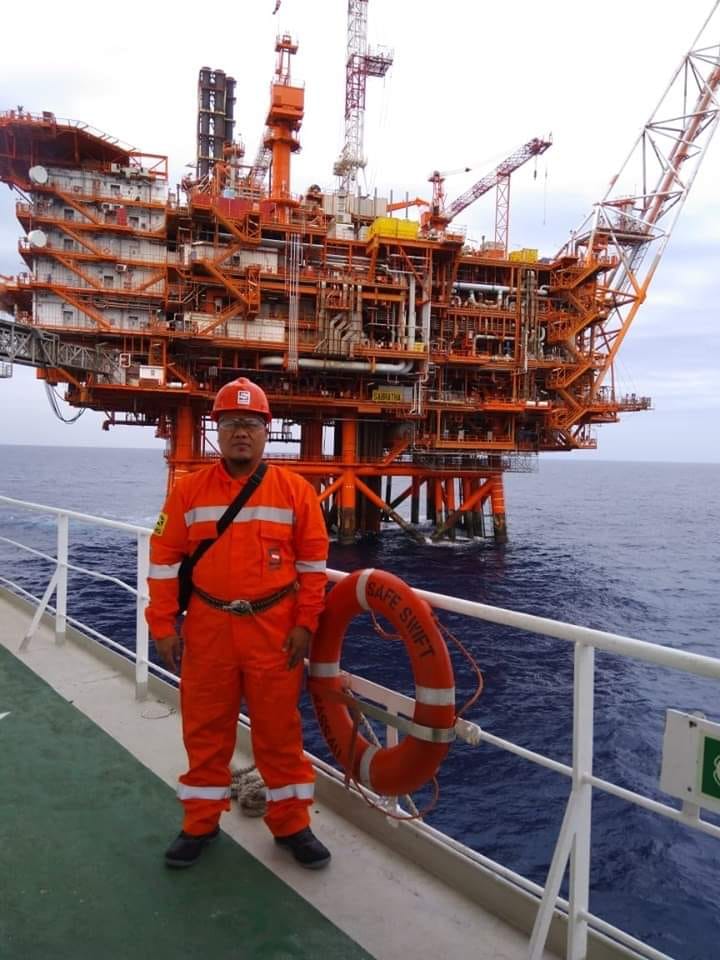
Bekerja di offshore (pelantar minyak) tak sama dengan bekerja di tempat-tempat biasa. Berjauhan dengan keluarga, anak bini serta girlfriend, kerja 12 jam sehari start jam 6.30 pagi sampai le jam 6.30 petang. Pergerakkan pun terbatas, banyak regulation yang kena patuhi.
Tentang safety pulak, number one. Sesetengah platform Petronas langsung tidak benarkan personnel keluar dari living quarters kalau tak pakai coverall, sebab safety. Mercury hazard Dan Hidrogen sulfida. Platform Supervisor ada hak untuk hantar balik pada sesiapa yang langgar safety regulation. Kena pakai PPE atau personnel protective equipment setiap masa sewaktu bekerja, kalau after working hour sekalipun kena pakai kalau keluar dari living quarters. Living quarters – tempat makan minum, tengok tv, mandi, rehat dan tidur.
Nak ke offshore pun perlu jalan urine test terlebih dulu, mana-mana personnel yang positive, minta maaf sila balik rumah, offshore bukan tempat untuk penagih. Sekarang Petronas dah kuat kuasakan peraturan ni di sebelah east coast ni. Mana-mana personnel yang nak ke Petronas platform mesti urine test dulu sebelum naik chopper. ExxonMobil, Talisman dan lain-lain buat masa ni belum start lagi.
Risiko pun tinggi, ombak besar, angin kencang, kerja-kerja yang dijalankan semuanya kerja yang robust. Takde kerja yang takde risiko. Life di offshore perlu alert 24 jam. Masih berminat nak bekerja di offshore ke?
Kelayakkan untuk bekerja di offshore
Bukan semua orang boleh atau layak untuk bekerja di offshore. Hanya mereka yang betul-betul fit dibenarkan berada di atas platform, mat fit tidak digalakkan sama sekali.
Turun dari platform to boat Basic requirement untuk bekerja di pelantar minyak.
Berusia at least 18 tahun ke atas – biasanya lepasan SPM lah. Sementara nak tunggu result tu ok juga cari pengalaman. Masalahnya sukar juga nak dapatkan company yang nak recruit worker yang tidak pernah ada pengalaman bekerja ni. Paling mudah gi register kat INSTEP – Institut Teknologi Petronas. Lawat web dia kalau nak tahu lebih lanjut. Tak jauh pun, area Batu Rakit Kuala Terengganu jer. Institut Teknologi PETRONAS (INSTEP – Batu Rakit Campus) Lot 9764, Mukim Batu Rakit, 21020, Kuala Terengganu, Terengganu Darul Iman, MALAYSIA Tel: 609 – 669 6141 Fax: 609 – 669 6702 Email: instep@petronas.com.my
Kalau dah grad dari INSTEP, ada rezeki boleh bekerja dengan di Petronas ataupun ExxonMobil platform. Tapi kalau kena hantar kat onshore macam di Onshore Gas Terminal, Paka ka.. nasib lah.
Safety Passport – Conpulsory, wajib. Bagaimana nak dapatkan safety passport ni. … kalau di sebelah pantai timur ni, TSTC menawarkan berbagai course untuk workers. Ada berpuluh-puluh courses di sini tetapi yang wajib untuk bekerja di offshore :
Basic sea survival course HUET – Helicopter underwater escape training Fire fighting Untuk bekerja di sebelah platform Petronas, anda perlu ada 4 courses. ExxonMobil setakat ini mewajibkan 3 courses. So tanpa course ini anda tidak akan dapat passport, takde passport maaf anda tidak dibenarkan
Walau bagaimanapun kalau anda seorang VIP, kalau takde anda maka kerja tak boleh buat, masih ada peluang untuk anda terlepas untuk sekali namun bergantung kepada keadaan.
Berapa ribu ringgit Malaysia? Untuk 4 courses ini ada perlu ada RMX,XXX.XX. Anda boleh contact TSTC atau layari website dia orang.
Terengganu Safety Training Center Sdn Bhd 3572, Jalan Panchur, Kawasan Perindustrian Teluk Kalong, 24000 Kemaman Terengganu Darul Iman Tell : 09-8623300 Fax : 09-8623302
Physically fit – Macam aku terangkan di atas, hanya personnel yang fit sahaja yang boleh bekerja di sana, yang jenis lemah lembik dinasihatkan tak perlu memohon lah. Alasan aku, kita akan bekerja di sebuah tempat yang kotor, bahaya, cuaca yang tak menentu atau ringkasnya kerja-kerja yang memerlukan kekuatan fizikal dan mental. Everything nak cepat, kalau lambat panas lah telinga. Begitu juga dengan crew-crew otai yang dah lama bekerja di sana, ada yang hampir 30 tahun! So puak-puak otai ni ada yang kasar ada yang sebaliknya. Kalau dapat bekerja dengan satu team yang baik tu ok lah, kalau puak yang satu lagi tu, alamat nak kena demob je lah.
Demob – balik ke onshore, atau back to town.
Mentallity Fit – Kalau cepat terasa hati, suka menangis, cepat tersentuh atau apa saja peel yang sewaktu dengan kaum hawa tu sekali lagi dinasihatkan tak perlu apply lah. Sebab, sendiri mau ingat kita nak bekerja di pelantar minyak nun di tengah laut, bukannya di kedai salun rambut. Medical check-up – Anda perlu jalani medical check-up terlebih dahulu, x-ray apa-apa yang patut. Jantung OK, paru-paru OK, mata OK dan semuanya OK. Kalau semua OK boleh jalan terus. So ini lah serba sedikit BASIC requirement untuk bekerja di offshore.
Jawatan Yang Ditawarkan
List di sini mungkin tidak lengkap, tetapi ini adalah antara regular position yang ada di offshore.
Helper – kalau bahasa kasarnya kuli, macam aku lah. Helper task dia membantu sesiapa sahaja yang perlukan bantuan, tak kira apa task sekalipun. Kerja biasanya lebih kepada nak memudahkan kerja-kerja orang lain, termasuklah tukang angkat spannar, bersihkan working area dan housekeeping. Ramai adik-adik lepasan SPM yang apply kerja ni. Estimated Salary : RM40.00-RM50.00, offshore rate, 12 hours working time.
Rigger – Atas sikit dari helper, nak jadi rigger pun kena join rigging course, bukan boleh pakai redah jer. Tasknya lebih kepada ringging job, lasak, seperti menarik dan menolak bebanan yang berat yang biasanya crane tak boleh operate. Kelebihan untuk mereka yang bertubuh sasa, mat fit tak sesuai. Estimated Salary : RM80.00-RM100.00, offshore rate, 12 hours working time.
Rigger Scaffolder – Rigger juga tetapi specialize dalam erect scaffolding, bahasa baku panggil perancah, tapi jangan ler sesekali sebut perencah kat offshore, nanti kena gelak dik. Tugasnya erect scaffolding untuk jadikan access platform dan panjat tempat tinggi menggunakan safety hardness. Estimated Salary : RM80.00-RM120.00, offshore rate, 12 hours working time.
Fitter – Fitter kerjanya fit up weld steel pipe atau structure, biasanya satu team dengan welder. Estimated Salary : RM90.00-RM130.00, offshore rate, 12 hours working time.
Welder -Welder, tugasnya menyambung pipe atau structure yang telah di fit up oleh fitter. Post ni boleh tahan, kalau banyak “lesen” boleh buat duit banyak. Lesen ni datangnya dari Welder Qualification Test (WQT) .. haaa translate la sendiri, memang dah gitu term nya. Kalau banyak lesen dipanggil multi skill, boleh weld material carbon steel, stainless steel, duplex, cuni etc ler. Orang kampung aku cakap juruteri.. wahaha. Estimated Salary : RM100.00-RM300.00, offshore rate, 12 hours working time.
Blaster – Blaster kerjanya blasts metal surface dengan menggunakan blasting equipment sebelum painter paints sesuatu surface, pipe ke structure ke.. mana-mana lah. Pakaian macam orang nak kebulan, rimas la sikit. Perlu ada IMM courses. Estimated Salary : RM70.00-RM90.00, offshore rate, 12 hours working time.
Painter – Painter pulak sambung kerja yang blaster dah buat, dia apply paint pada surface tu. Sama la kena pakai pakaian ke bulan jugak. Perlu ada IMM courses. Estimated Salary : RM70.00-RM90.00, offshore rate, 12 hours working time.
Electrician – Nama pun electrician, kerja-kerja berkenaan dengan electric di platform. Estimated Salary : RM100.00-RM120.00, offshore rate, 12 hours working time.
Instrument Fitter – Instrument fitter tasksnya berkenaan dengan bahagian instrument, process, tubing etc. Rilex jer kerja ni, tak berat langsung. Estimated Salary : RM90.00-RM100.00, offshore rate, 12 hours working time.
Crane Operator – Operate platform crane.. huii kena ada course ni, kalau boleh bawak crane di onshore belum tentu boleh bawak crane di offshore. Estimated Salary : RMxx.00-RMxx.00, offshore rate, 12 hours working time.
Professional posts – Graduates from Chemistry, Physics, Engineering, Mathematics, Geology, Geophysics and Petroleum Engineering courses are all of interest to offshore companies in exploration and production activities such as:
Geologists and Geophysicists Reservoir engineers Drilling engineers Petroleum engineers
Dan jika anda ada pengalaman kerja melebihi 10 tahun dalam bidang kemahiran anda, bolehlah pertimbangkan untuk dilantik sebagai Personal Penilai & Verifikasi.
Jika anda ingin menjadi underwater welder pula, ini adalah maklumat kursus untuk pertimbagngan anda.
Kursus underwater welding
🔸 Harga Yuran Kursus : 1) Commercial Diving Level 1 = RM12,000.00 2) Commercial Diving Level 2 = RM12,000.00 3) Underwater Welding & Underwater Cutting = RM24,000.00 Jumlah penuh ialah RM48,000.00.
HARGA ROMOSI 2020 RM42,000.00
Kursus mengambil masa 3 bulan atau lebih (Full Time/Sepenuh Masa)
Pembayaran yuran penuh boleh dilakukan secara berperingkat (sepanjang 3 bulan dalam tempoh latihan)
🔹Kos yuran termasuk pakej : 1) Penginapan homestay 2) Makan & minum 3) Nota Pelajaran 4) Pensijilan 5) Logbook Official 6) Pakaian untuk latihan disediakan (Coverall & TShirt Weldzone Official).
TAWARAN PERCUMA UNTUK PELAJAR BARU Kursus Aqua Jet Underwater Blasting & Underwater Painting akan diberikan secara PERCUMA didalama silibus pelajaran dan praktikal. Kursus percuma ini diberikan jika pelajar mengambil kursus penuh sahaja (Level 1, Level 2 & Level 3) – (Selagi promosi masih sah sahaja)
✔ BOOKING / DAFTAR MASUK Deposit RM5000 untuk : 1) Diving Medical Check Up (1 Hari di Ipoh, Perak) 2) First Aid Class 3) Scuba Diving
📌 Syarat Kelayakan untuk menyertai : 1) Warganegara perlu menyediakan salinan kad pengenalan depan / belakang. 2) Warga luar (Foreigner) salinan passport. 3) Berumur 18 tahun ke atas. 4) Sihat tubuh badan (tiada penyakit kronik asma, semput dll) 5) Mampu membaca, menulis, membuat kiraan matematik asas. 6) Keadaan kewangan yang mencukupi untuk memasuki latihan, untuk mengelakkan penangguhan bayaran yuran kursus serta penerimaan lesen dan sijil.
Pengiktirafan sijil dan lesen :
Pusat Latihan
diiktiraf oleh International Technical Diving Agency (Europe) bagi ASIA
About one-third of manufacturing workers holds a bachelor’s degree in 2016, up from only 8% in 1970, according to a new report from Georgetown University’s Center on Education and the Workforce. Meanwhile, the share of workers with a high school degree or less shrunk from 79% to 43% over the same time period.
Manufacturing employs about 12.6 million workers, down from a high of nearly 20 million in 1979. Automation has displaced millions of workers and taken over many routine tasks, causing more manufacturing positions to require or degree or credential.
The center projects that the sector will shed 2% of its workers with a high school diploma or less by 2027. There will be 200,000 fewer “good jobs” — or those that make at least $35,000 — for those with bachelor’s degrees, but 300,000 more good jobs for workers with middle skills.
When it comes to evaluating mass notification solutions, where should you start? First, it is important to understand the technology, what it can do for your organization and how it works.
Dive Insight:
The research further supports two well-documented trends: the dramatic narrowing of the job market in manufacturing and the growing need for postsecondary training for industry jobs – particularly through associate degrees and credentials.
However, even the number of good manufacturing jobs available to workers without a bachelor’s degree has been dwindling, from 7.2 million in 1991 to 4.8 million in 2016. Meanwhile, middle-skill jobs, or those where workers have more than a high school education but less than a bachelor’s degree, account for some of the biggest growth in the sector. For example, the number of associate degree-holders with good manufacturing jobs grew to 1 million in 2016.
The center notes that nondegree credentials also boost the chances that manufacturing workers will get a good job, regardless of their level of education. Having a certification or license, for example, improves the chances that workers with a high school diploma will find a good manufacturing job by 18 percentage points.
Many have lauded credentials a way to quickly upskill workers for the ever-changing needs of the job market. And indeed, research from the Lumina Foundation and the Strada Education Network found that those with nondegree credentials are more likely to report having a full-time job than those without credentials.
As such, the credential marketplace have been growing, with even soft skills on offer at some universities. There’s also been a growing call for universities to embed certifications within their degree programs. That way, the thinking goes, colleges can keep their curriculum current and give students proof of in-demand skills before they graduate.
The Lumina Foundation has found value in the approach but notes that such efforts haven’t been closely monitored for their effect on labor market outcomes. It may, however, prove to be one way for colleges to better meet the needs of U.S. employers, who often voice their difficulty with finding skilled workers.
Source: www.educationdive.com
Comment: Likewise, technical and vocational graduates or commonly known as TVET in Malaysia, should pursue a Bachelor or Masters degree in order to be able to scale higher in their career or business. It’s no more a dream for TVET graduates, despite not having SPM or poor SPM results, to further their studies beyond Diploma (whether it’s Diploma Kemahiran Malaysia (DKM) or Diploma Vokasional Malaysia (DVM)).
There are now 5 public technical universities that’s officially accepting TVET diploma holders. Many may not be aware that some private universities have also been accepting these TVET diploma holders (without or with poor SPM results) but soon (perhaps another month or so), an official announcement would be made to provide a second chance to these group of technically inclined graduates who may not excel academically.
If you want to know more about the opportunity available for you to pursue a Bachelor or Masters Degree as a TVET graduate, you may APPLY HERE
Universiti Malaysia Kelantan (UMK) menjadi universiti kelima yang menerima lepasan pelajar Diploma Institusi Latihan Jabatan Tenaga Manusia (ILJTM).
KOTA BHARU: Lepasan diploma program Pendidikan Teknikal dan Latihan Vokasional (TVET) digalakkan menyambung pengajian kemahiran ke peringkat sarjana muda yang ditawarkan universiti tempatan.
Timbalan Menteri Sumber Manusia Datuk Mahfuz Omar berkata pelbagai universiti tempatan kini menawarkan pengajian ijazah yang bersesuaian melalui kerjasama dengan Jabatan Tenaga Manusia (JTM) dalam usaha memperkasa TVET.
“Universiti Malaysia Kelantan (UMK) menjadi universiti kelima yang menerima lepasan pelajar Diploma Institusi Latihan Jabatan Tenaga Manusia (ILJTM).
“Sebelum ini, tawaran pengajian Ijazah ini dijalankan di bawah rangkaian Universiti Teknologi Malaysia dengan gabungan empat universiti iaitu Universiti Malaysia Perlis (UniMAP), Universiti Teknikal Malaysia Melaka (UTeM), Universiti Tun Hussein Onn Malaysia (UTHM) dan Universiti Malaysia Pahang (UMP),” katanya ketika ditemui pada majlis menandatangani Perjanjian Persefahaman (MoU) antara UMK dan JTM di UMK Kampus Bachok di sini hari ini.
Mahfuz menyaksikan pemeteraian MoU itu yang ditandatangani Ketua Pengarah Jabatan Tenaga Manusia, Datuk Muhd Khair Razman Mohamed Annuar dan Naib Canselor UMK, Prof Dr Noor Azizi Ismail.
MoU selama tiga tahun itu bermatlamat untuk membolehkan graduan diploma melanjutkan pengajian ke peringkat lebih tinggi.
Katanya, penawaran itu antara lain memberi peluang kepada pelajar kemahiran mendapat pekerjaan yang lebih baik dengan pendapatan yang lebih tinggi.
“Kerjasama sebegini membentuk semula keyakinan ibu bapa terhadap bidang TVET, kalau dulu tidak berapa yakin dengan pendidikan bidang kemahiran, kini pelajar boleh sambung pengajian hingga ke peringkat ijazah sarjana muda.
“Cuma kita mahu graduan TVET ini mencipta peluang pekerjaan baru atau mencipta produk,” katanya.
Beliau berkata, kerjasama bagi tempoh tiga tahun itu juga merangkumi kerjasama kedua-dua pihak dalam perkongsian teoritikal, teknikal dan praktikal dalam bidang teknik dan vokasional.
“Antara bidang pengajian yang jadi tumpuan kita pula di bidang pemasaran internet, sebab mahu memenuhi keperluan industri dalam menghadapi arus Gelombang Revolusi Perindustrian Keempat (IR 4.0).
“TVET bukan hanya kemahiran teknikal tapi kita juga seiringkan kemahiran lain seperti sektor pertanian yang kita pertingkatkan menggunakan teknologi semasa sebab itu kita juga mahu kementerian lain seperti Kementerian Perdagangan Antarabangsa dan Industri (MITI) untuk bawa pelaburan yang boleh mengguna pakai kemahiran yang dimilik pelajar TVET,” katanya.
Sumber: BERNAMA
KOMEN:
Sekarang dah ada 5 Universiti tempatan (IPTA) yang menerima graduandiploma TVET secara rasmi. Namun, ramai lagi yang tidak tahu bahawa sesetengah Universiti Swasta (IPTS) juga menerima lepasan sijil/diploma TVET (tanpa atau dengan keputusan SPM yang lemah).
Sabar, akan ada pengumuman rasmi dalam masa terdekat (mungkin dalam masa sebulan dua ni), untuk memberi peluang kedua untuk anda yang berkecenderungan teknikal dan tidak menyerlah secara akademik.
Jika anda ingin tahu tentang peluang yang ada untuk anda sambung ke Ijazah Bachelor atau Masters sebagai seorang graduan TVET, anda boleh MOHON SINI
(File pix) Only 13 per cent of all upper secondary students are pursuing TVET courses, while merely nine per cent are doing them at polytechnics. Pix by NSTP/Aizuddin SaadBy New Straits Times – June 11, 2019 @ 12:01am
THE world of technical and vocational education and training (TVET) is one of paradoxes and other mind bogglers.
Five thousand TVET and science places are waiting to be filled, yet there are no takers. Puzzlingly, too, TVET grad employability is a very high 95 per cent versus tertiary institution grad employability of an average of 80 per cent.
This the parents and students do not know, says Education Minister Dr Maszlee Malik. Little wonder, only 13 per cent of all upper secondary students are pursuing TVET courses, while merely nine per cent are doing them at polytechnics.
A 2018 report by Khazanah Research Institute (KRI) on The School-To-Work Transition of Young Malaysianslends support to the minister’s claim.
The report quotes job seekers as saying TVET to be the most useful qualification for getting a good job. Yet — here comes another mind boggler — TVET is not a popular education pathway. As Maszlee says, there may need to be a deeper analysis. We agree.
Perhaps, the problem may not be in TVET itself, but in everything associated with it. This maze must be untangled. Consider this.
There are more than 1,000 public and private TVET institutions — 565 public institutions under six ministries and 600 private institutions.
This causes a plethora of problems, says the KRI report. One such is a lack of strategic coordination. This should have been to some extent solved by the Malaysia Board of Technologies — a governance and certification body — launched on Nov 17, 2016. But fragmentation continues. The puzzle thickens.
“Low wages” appear to be standing in the way of TVET, too. To Maszlee, this is a perception problem. It may very well be. And can be solved with some generous dose of awareness.
Remuneration is based on TVET skills acquired and as the skills are upgraded along with the experience gained, salary tends to move up.
But there is hope yet. Maszlee says a cabinet-level committee is hard at work consolidating resources as well as synchronising efforts to ensure stronger branding, more effective governance, funding and accreditation structures to make TVET a primary choice for students.
We will hold our horses until the more “sexy” TVET arrives. Part of this reform involves making the TVET industry responsive, according to deputy director-general at the Education Ministry’s Polytechnic and Community College Education Department, Dr Mohammad Naim Yaakub.
The idea is, he says, to make supply match demand by way of artificial intelligence and big data. This has been the experience of many European countries. European countries have skewed their skills development policy towards encouraging such a match.
KRI sees competency-based training as critical to TVET reform. This allows for the design of practical, demand-driven courses for industry needs.
Competency-based TVET uses short modular courses geared to market industry demand, enabling students to enter the market with a defined set of skills.
Modular courses also come with additional advantages: they promote lifelong learning and are less time-intensive. The rest of the world is heading towards short “nano degrees”. We should too.
Comment: Again, would like to point out that one factor that maybe left out is the fact that current Sijil Kemahiran Malaysia (SKM) & Diploma Kemahiran Malaysia (DKM) holders are facing stumbling block in furthering their study to higher education due to SPM qualification issues, ie passing BM & History and/or with 3 credits as per required by MQA.
KUALA LUMPUR: MORE than 5,000 technical and vocational education and training (TVET) courses and science courses offered by universities, polytechnics and technical universities have not been taken up.
Although those courses have greater job prospects, students are not enrolling in those classes.
They include sustainability science, applied plant science, forest resource technology, product development technology, natural resources science, agribusiness, applied physics, industrial chemical technology and business engineering.
Since 2017, 1,251 courses in public universities have been suspended or cancelled. This number is almost 30 per cent of the total courses offered in public universities.
“Maybe it’s not ‘sexy’ enough, but students don’t understand that those courses allow them to be employed even before they graduate,” said Education Minister Dr Maszlee Malik in an interview with the New Straits Times Press.
He cited the cybersecurity course offered by Politeknik Mersing, where students could gain employment even before graduating.
“But when it comes to TVET courses, people do not understand as it is a term that explains everything under the sun, and it may be too vast.
Kolej Vokasional Setapak fashion students staging a show in Cheras, Kuala Lumpur, recently. FILE PIC
“What I like to emphasise is that there are jobs available in those courses.”
He also said the number of non-Bumiputera students enrolling in polytechnics and technical institutions was very low, and many were focused on entering matriculation and public universities.
“It’s (matriculation) not the only path. We have Form Six, polytechnics, diploma studies and the Teachers’ Education Institute, which do not have any quota. So now, we want others to look at the bigger picture.”
However, Maszlee said there were weaknesses in the ministry’s steps to disseminate information and guide people through the options. In April, he had said the ministry was looking into rebranding TVET programmes, and this included the possibility of changing its name to a more appealing one.
He said the ministry would make TVET a mainstream education choice for students because they viewed it only as a second option and believed it might not help them much in the future.
Source: www.nst.com.my
Comment: Poor public perception aside, I think following are few other issues: 1. The Education Ministry & Human Resource Ministry has not been promoting enough about TVET courses & it’s future & more importantly, effectively. 2. If I’m not mistaken, entrance requirements to these universities, polytechnics and technical universities still requires a pass in SPM BM & History or 3 credits. This actually deprives many SKM or DKM holders who may not qualify academically but yet they are the ones that are inclined to further their study in these technical courses.
“This is why the partnership with private TVET institutions is important. In order to produce a bigger percentage of skilled workers, it is vital for both private and public TVET institutions to work closely with us.
“Though TVET focuses on the technical, electronic, electrical, civil engineering, ICT, but we will diversify to hospitality courses soon, because it is a platform that nurtures the interest of the youth.
“In the long term, we want graduates to become entrepreneurs, where they can apply for funding from the skilled development corporate fund when they have undergone the programmes and obtained a certificate,“ he said.
“We have 32 institutions under the Manpower Department – the industrial training institutes, the Japan Technical Institute in Penang, and advanced technologies centres, which besides running full-time courses, also organise short courses to cater for working adults. Our institutions are open to 11pm.”
Muhd Khair said TVET graduates are equally competent as compared with other graduates from various colleges and universities.
.JPG)